
A customer missing an invoice due date does not mean you have a bad debt.
It starts as a late payment. You may still be able to recover the full amount with a reminder, a phone call, or a payment arrangement. The problem becomes more serious when the invoice stays unpaid, the customer stops responding or there is evidence that the money is unlikely to be recovered.
This is where late payment can turn into bad debt.
For Australian businesses, the important question is not simply how old an unpaid invoice is. You need to know what steps to take, when further recovery may not be worthwhile, and what happens if the debt is eventually written off.
This guide follows the process from late payment to bad debt, including the income tax and GST rules that may apply.
TL;DR
- A late payment is an invoice that has not been paid by the agreed due date.
- A bad debt is different. It is a debt that has become genuinely unlikely to be recovered and is written off as bad.
- The two should not be treated as the same thing.
- A sensible process is:
- Invoice due → payment becomes late → investigate the reason → chase the payment → escalate recovery → assess whether the debt is recoverable → write off if genuinely bad → review tax and GST treatment.
- There is no general income tax rule saying an invoice becomes a bad debt after a set number of days. The ATO looks at the facts and whether the debt is genuinely bad rather than merely doubtful.
- For income tax, section 25-35 of the Income Tax Assessment Act 1997 allows a deduction for a debt, or part of a debt, written off as bad where the relevant requirements are met, including that it was included in assessable income for the relevant or an earlier income year for an ordinary business.
- GST has separate rules. A qualifying unpaid debt may give rise to a GST adjustment when it is written off as bad or has been overdue for 12 months or more.
What Is a Late Payment?
A late payment happens when a customer does not pay an invoice by the agreed due date.
For example, your terms might require payment within 14 days. If the customer has not paid after those 14 days, the invoice is overdue.
That does not necessarily mean there is a serious problem.
The customer may have:
- missed the invoice
- sent it to the wrong person for approval
- found an error in the invoice
- misunderstood the payment terms
- raised a genuine dispute
- had a short-term cash flow problem
- simply forgotten to pay
The first job is therefore to find out why the payment is late.
Australian Government guidance recommends checking the contract and payment terms first, then contacting the customer and discussing payment or a payment schedule where appropriate.
Not sure how late payments or bad debts may affect your tax return? Get personalised personal income tax advice in Perth from ISM Accountants & Advisors. We can help you understand what you may be able to claim and ensure your tax return is prepared correctly.
When Does Late Payment Become a Bad Debt?
This is the key distinction. A late payment is about timing. A bad debt is about recoverability.
An invoice can be 30 days late and still be completely recoverable. Another debt may become bad sooner if, for example, the customer has gone into liquidation and there is little realistic chance of receiving the money.
Think about the difference this way:
Stage | What is happening? | What you should consider |
Payment due | Invoice is within its agreed terms | Monitor |
Late payment | Due date has passed | Contact the customer |
Seriously overdue | Payment remains outstanding | Escalate recovery |
Doubtful debt | You have concerns about recovery | Assess the customer’s position |
Bad debt | Recovery is unlikely | Consider write-off and tax treatment |
The ATO states that whether a debt is bad depends on an objective assessment of the relevant circumstances. A debt must be more than merely doubtful.
That is why “90 days overdue” is not, by itself, a bad-debt test.
Recommended Read: How to Manage Business Debt and Improve Financial Health in Australia?
What Should You Do When a Customer Pays Late?
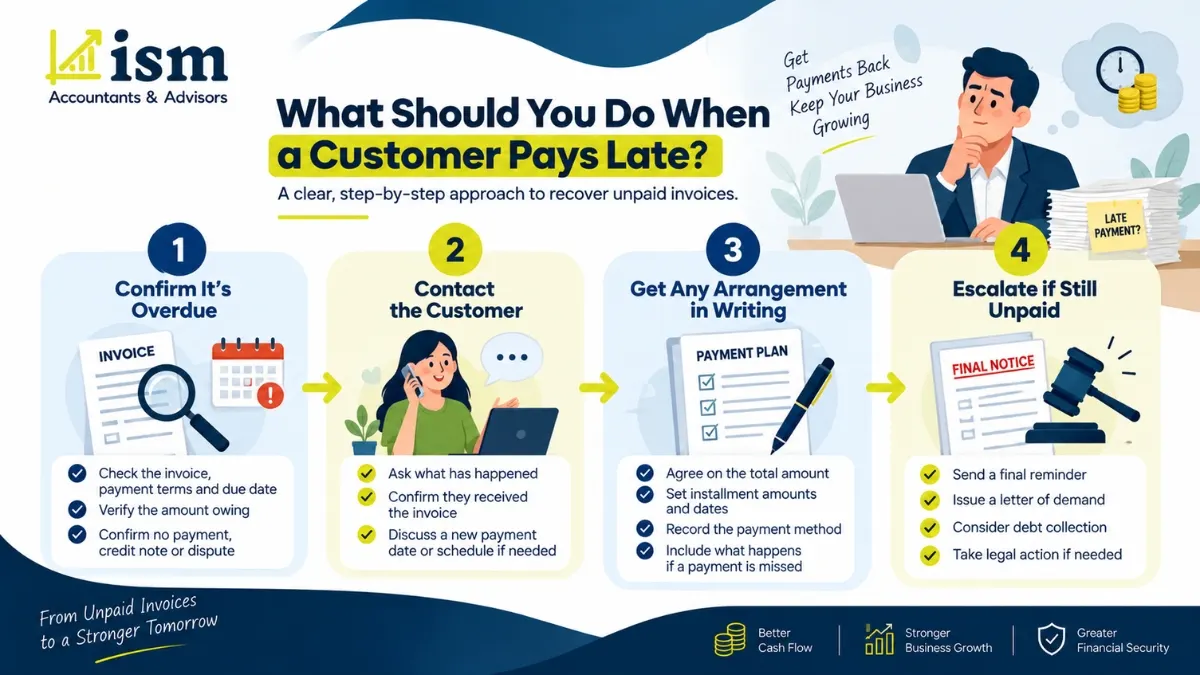
The best response depends on how late the payment is and why it has not been made.
You do not need to jump straight from a missed due date to a debt collector.
A staged approach gives you a better chance of recovering the money without unnecessary cost.
Step 1: Confirm the payment really is overdue
Check:
- the original invoice
- the agreed payment terms
- the due date
- the amount owing
- whether payment has already been received
- whether a credit note or adjustment is pending
Also check whether there is a genuine dispute.
If your invoice is incorrect or the customer has a valid complaint about the goods or services, fixing the underlying issue may resolve the late payment faster than repeated demands for payment.
Step 2: Contact the customer
Start by asking what has happened.
A simple message can confirm whether:
- They received the invoice
- The invoice is waiting for approval
- There is a problem with the work
- They need another copy
- They are experiencing temporary financial difficulty
- They can give you a realistic payment date
Australian Government guidance recommends starting with a reminder and discussing a new payment date or payment schedule if needed.
Step 3: Get any payment arrangement in writing
If the customer cannot pay the full amount immediately, you may agree to installments.
Do not rely only on a verbal promise.
Record:
- The total amount owing
- Each installment
- Payment dates
- The agreed payment method
- What happens if a payment is missed
This gives both sides a clear understanding of the arrangement.
Step 4: Escalate if the payment still does not arrive
If reminders and agreed payment arrangements fail, it may be time for a more formal recovery step.
Depending on the circumstances, this may include:
- A final payment reminder
- A letter of demand
- Dispute resolution
- A debt collection service
- Legal action
Australian Government guidance places a letter of demand after unsuccessful reminders and allows businesses to consider debt collection where earlier recovery efforts have not worked.
Recommended Read: Australian Tax Law For Small Businesses
When Should You Stop Treating It as a Normal Late Payment?
At some point, an overdue invoice becomes a collection-risk issue rather than a simple late payment.
Look more closely when:
- The customer repeatedly breaks payment promises
- The customer stops responding
- Emails and calls are ignored
- The business appears to have stopped trading
- The customer enters liquidation or bankruptcy
- Recovery attempts have failed
- The customer has no apparent assets from which the debt could be recovered
- The cost of recovery is becoming disproportionate to the debt
- There is other evidence that recovery is unlikely
These signs do not automatically make a debt bad.
They are reasons to assess whether it has moved from overdue to unlikely to be recovered.
The ATO’s bad-debt ruling gives examples including an untraceable debtor, a company in liquidation with insufficient funds and situations where, based on the facts, there is little or no likelihood of recovery.
What Evidence Can Show That a Debt Is Bad?
There is no single document that proves every bad debt.
Instead, you should be able to show the circumstances surrounding the debt and what you did to recover it.
Useful evidence can include:
- The original invoice
- The contract
- Payment terms
- Customer statements
- Reminder emails
- Phone records or notes
- Payment promises
- Failed payment arrangements
- A letter of demand
- Debt collection records
- Legal documents
- Liquidation or bankruptcy information
- Evidence that the customer cannot be contacted
- Records showing the decision to write off the debt
The ATO’s ruling says that appropriate recovery steps will vary depending on the size of the debt and the resources available to the creditor. Examples include reminder notices, contact attempts, formal demands and, where appropriate, legal recovery steps.
This is important because you do not necessarily need to take every possible legal step for every small invoice.
The recovery process should make commercial sense.
Is a 90-Day Late Payment a Bad Debt?
Not automatically.
This is one of the areas where businesses can easily confuse an internal credit-control rule with a tax rule.
You might decide internally that invoices over 90 days old need management attention.
That is sensible.
But 90 days overdue does not automatically make the debt bad for income tax purposes.
The ATO’s GST ruling gives a useful example: even where a debt is 90 days outstanding after a 90-day credit period, the debt is not accepted as bad simply because that period has passed, unless there are other factors supporting that conclusion.
The question is whether the debt is genuinely unlikely to be recovered.
Is a 12-Month Late Payment a Bad Debt?
Not automatically for income tax.
The 12-month period is important under the GST rules, but it should not be treated as a general income tax rule for bad debts.
For GST purposes, a qualifying debt can give rise to an adjustment if it has been overdue for 12 months or more.
For income tax, the question remains whether the debt is bad and whether the requirements for a bad debt deduction are satisfied.
This distinction is worth making very clearly:
12 months overdue ≠ automatically an income tax bad debt.
Recommended Read: How to Reduce Taxable Income?
What Is the Tax Treatment of a Bad Debt?
Once a late payment has genuinely become a bad debt, tax treatment becomes relevant.
Section 25-35 of the Income Tax Assessment Act 1997 provides a deduction for a debt, or part of a debt, that is written off as bad in the income year where the relevant requirements are met. For an ordinary business, the debt must have been included in assessable income for that year or an earlier year.
The basic pathway is:
Customer owes money → amount included in assessable income → debt becomes genuinely bad → debt is written off → deduction considered.
This does not mean every unpaid invoice qualifies.
For example, if an amount was never included in assessable income, the bad-debt deduction rules may not provide a deduction simply because the customer failed to pay.
Your accounting method and circumstances also matter.
Does a Bad Debt Need to Be Written Off For Tax?
Yes, writing the debt off is an important part of the income tax bad-debt rules.
The ATO’s ruling states that the bad debt must be written off in the relevant income year before the deduction is available. It also explains that the write-off does not require a complicated accounting entry; a written record showing the decision to write off the debt can be sufficient evidence of the decision.
This means you should not simply leave an old invoice sitting in your accounts and assume it has been written off for tax purposes.
Keep a clear record of:
- The invoice
- The amount being written off
- The reason
- The date of the decision
- Who approved the write-off
Unsure whether a bad debt qualifies for a tax deduction or whether your write-off records meet ATO requirements? ISM Accountants can help you understand the rules, review your records, and make sure your tax affairs are handled correctly.
Get professional tax advice and support from our experienced accountants.
Can You Write Off Part of a Bad Debt?

Yes, in some circumstances.
You may recover part of an invoice but determine that the remaining amount is unlikely to be recovered.
For example:
- Customer owes $20,000.
- You recover $8,000 through a payment arrangement.
- The remaining $12,000 becomes genuinely unrecoverable.
The remaining amount may need to be considered separately for write-off and tax purposes.
Section 25-35 expressly allows a debt or part of a debt to be deductible where the relevant conditions are satisfied.
What Happens to GST on a Bad Debt?
GST needs to be considered separately from income tax.
If your business made a taxable supply, attributed the GST on that supply on its BAS and has not received all or part of the consideration, the GST rules can provide a decreasing adjustment where the debt is written off as bad or has been overdue for 12 months or more.
For a wholly taxable supply, the ATO states that the decreasing adjustment is generally 1/11 of the amount written off as bad or overdue for 12 months or more, subject to the applicable rules.
For example, if $11,000 including GST remains unpaid and the qualifying GST rules are satisfied, the GST component is generally $1,000.
However, do not apply the calculation blindly. The original supply, GST treatment and amount actually unpaid all need to be considered.
Recommended Read: GST For Small Businesses
What Happens If You Recover a Bad Debt Later?
Writing off a bad debt does not guarantee that the customer will never pay.
You may later recover some or all of the money.
If you previously received a GST decreasing adjustment for the bad debt, the later recovery can result in an increasing GST adjustment for the amount recovered.
For income tax, the later recovery also needs to be accounted for correctly based on the earlier treatment.
Keep the original write-off records and details of the later payment.
Do not simply put the recovered money through your accounts as if the original bad-debt treatment never happened.
Late Payment and Bad Debt: A Practical Decision Table
Situation | Recommended focus |
The invoice is just overdue. | Contact the customer |
The customer forgot to pay. | Send a reminder |
The customer has a temporary cash flow problem | Consider a written payment plan |
The customer disputes the invoice. | Resolve the dispute |
The customer ignores repeated reminders | Escalate recovery |
The customer has stopped trading. | Investigate collectability |
The customer is insolvent. | Review likely recovery |
Recovery is unlikely. | Consider bad-debt treatment |
Debt is written off. | Review income tax and GST |
Written-off debt is later recovered. | Review the tax and GST consequences |
This approach keeps late payment management separate from the point where the debt becomes a genuine bad-debt issue.
How Can Businesses Reduce the Risk of Late Payment?
Preventing late payment is still important, but the focus should be on controls that stop an overdue invoice from progressing further.
Set a clear payment date
Your customer should not have to guess when payment is due.
Business.gov.au recommends putting payment terms in your contracts and invoices and clearly explaining accepted payment methods, due dates and how overdue debts will be handled.
Make invoices easy to check
Incorrect or unclear invoices can create avoidable disputes.
Include:
- invoice number
- invoice date
- due date
- description of the goods or services
- amount payable
- payment details
- relevant tax information
Australian Government guidance says clear and correct invoices can help prevent disputes and payment delays.
Watch your accounts receivable
Do not wait until the end of the financial year to review unpaid invoices.
A simple ageing report can show which customers are:
- not yet due
- recently overdue
- seriously overdue
- repeatedly late
- at risk of becoming bad debts
Act before the invoice becomes seriously overdue
Business.gov.au recommends following up unpaid invoices quickly as part of cash-flow management.
The earlier you identify a problem, the more recovery options you usually have.
Final Thoughts
Late payment and bad debt are not two separate problems. They are often two stages of the same problem.
A customer misses the due date. You follow up. The invoice remains unpaid. You escalate recovery. You then have to decide whether the customer is likely to pay or whether the debt has become genuinely unrecoverable.
That decision matters.
Do not write off an invoice simply because it is old. At the same time, do not keep spending money chasing a debt when the evidence shows there is little chance of recovery.
For Australian businesses, the tax treatment comes after the commercial assessment. A bad debt deduction under section 25-35 has specific requirements, including the requirement for the debt to be written off as bad and, for an ordinary business, to have been included in assessable income.
GST has its own rules, including the 12-month overdue pathway for qualifying debts.
The safest approach is to keep good records from the first late-payment reminder through to the final write-off decision. If the amount is significant or the tax treatment is unclear, get professional advice before making the write-off or claiming an adjustment.
If you are still confuse what to do, you can reach out to ISM Accountants & Advisors for consultation.
Frequently Asked Questions
What is the difference between late payment and bad debt?
A late payment is an invoice that has passed its agreed due date. A bad debt is a debt that has become genuinely unlikely to be recovered and has been written off as bad.
How long can an invoice be overdue before it becomes a bad debt?
There is no fixed income tax period. An invoice does not automatically become a bad debt after 30, 60, 90 or 120 days. The facts and likelihood of recovery must be considered.
Is a 90-day overdue invoice a bad debt?
Not automatically. The ATO’s GST ruling specifically notes that a debt remaining unpaid after a 90-day credit period is not, by itself, enough to establish that the debt is bad.
Does an unpaid invoice become a bad debt after 12 months?
Not automatically for income tax. The 12-month period is relevant to certain GST adjustments. Income tax has a separate test for whether the debt is bad.
Can I claim a tax deduction for a late payment?
Not simply because the payment is late. A bad debt deduction is subject to the requirements in section 25-35, including the relevant assessable-income and write-off requirements.
Can I claim a tax deduction for an unpaid invoice?
Potentially. For an ordinary business, the debt generally needs to have been included in assessable income and written off as bad in the relevant income year, along with meeting the other applicable requirements.
Do I need to take legal action before writing off a bad debt?
Not necessarily. The appropriate recovery steps depend on the circumstances, including the size of the debt and the likelihood of recovery. The ATO recognises that recovery steps vary between cases.
Can I write off part of an unpaid invoice?
Potentially. Section 25-35 allows for a debt or part of a debt to be deductible where the applicable requirements are satisfied.
Can I get a GST adjustment for a bad debt?
Potentially. Where the GST requirements are met, a decreasing adjustment can arise when a qualifying debt is written off as bad or has been overdue for 12 months or more.
What happens if I recover a bad debt after writing it off?
The later recovery needs to be accounted for. If a GST decreasing adjustment was previously made, the recovery can result in an increasing GST adjustment.
How to deal with Bad Debts?
Deal with bad debts by following up promptly, taking reasonable recovery steps, documenting your efforts, and writing off genuinely unrecoverable debts while checking the applicable tax and GST treatment.