

Starting up a business is kind of exciting, but if you’re chasing limited liability, some solid investor credibility, and real room to scale later, you’ll usually need to move past a sole-trader setup. Learning how to set up a Pty Ltd company in Australia is often the next move for most founders, and the process is more involved than just registering a business name, but it becomes pretty straightforward once you actually understand what’s required.
This guide covers the whole company registration journey in Australia, from picking a company name all the way to opening your business bank account, including costs, timelines, the common go-gets people make, and answers to the questions founders tend to ask most.
Key Takeaways
- A Pty Ltd company is this kind of separate legal entity; it gives limited liability, and it’s also the usual setup for founders who are moving past a sole-trader kind of arrangement.
- Before you register, make sure you’ve sorted out your company name, director IDs, share structure, and registered address, so everything’s lined up.
- The company registration steps in Australia go through ASIC, using Form 201, and that’s what leads to your ACN and Certificate of Registration.
- Once it’s registered, you then apply for your ABN, TFN and GST (if needed), and after that, open a dedicated business bank account, separate from your personal banking.
- Afterwards the ongoing compliance stuff, annual reviews, solvency resolutions, and director duties are just as important as the initial registration process, seriously.
- Getting Pty Ltd company requirements right the first time avoids delays, extra charges, and those later compliance headaches.
What Is an Australian Proprietary Limited Company?
A proprietary limited company, you know, the one written as “Pty Ltd,” is basically the most common setup in Australia. It’s a separate legal thing from its owners, so in practice it can hold assets, enter contracts, and yes, get sued under its own name.
Since the business entity is legally distinct from its directors and shareholders, an Australian Proprietary Limited Company usually helps keep your personal assets away from business debts, as long as you actually meet your director duties and you don’t end up signing personal guarantees. That’s kind of the big reason many founders pick incorporation instead of just running as a sole trader, straight away.
Also, a Pty Ltd company can have up to 50 non-employee shareholders, it must have at least one director , and it’s overseen by the Australian Securities and Investments Commission (ASIC) under the Corporations Act 2001.
Pty Ltd vs. Other Business Structures
Structure | Liability | Best for |
Sole Trader | Unlimited personal liability | Solo freelancers, very low-risk ventures |
Partnership | Shared unlimited liability | Small, low-risk ventures with 2+ owners |
Pty. Ltd. Company | Limited liability | Founders wanting protection, investment, or growth |
Company Limited by Guarantee | Limited liability | Not-for-profits and associations |
If you’re planning to raise capital, bring on a co-founder, or simply want a professional structure that protects your personal assets, starting a Pty Ltd company is usually the best option.
How to Register a Pty Ltd Company: Step-by-Step
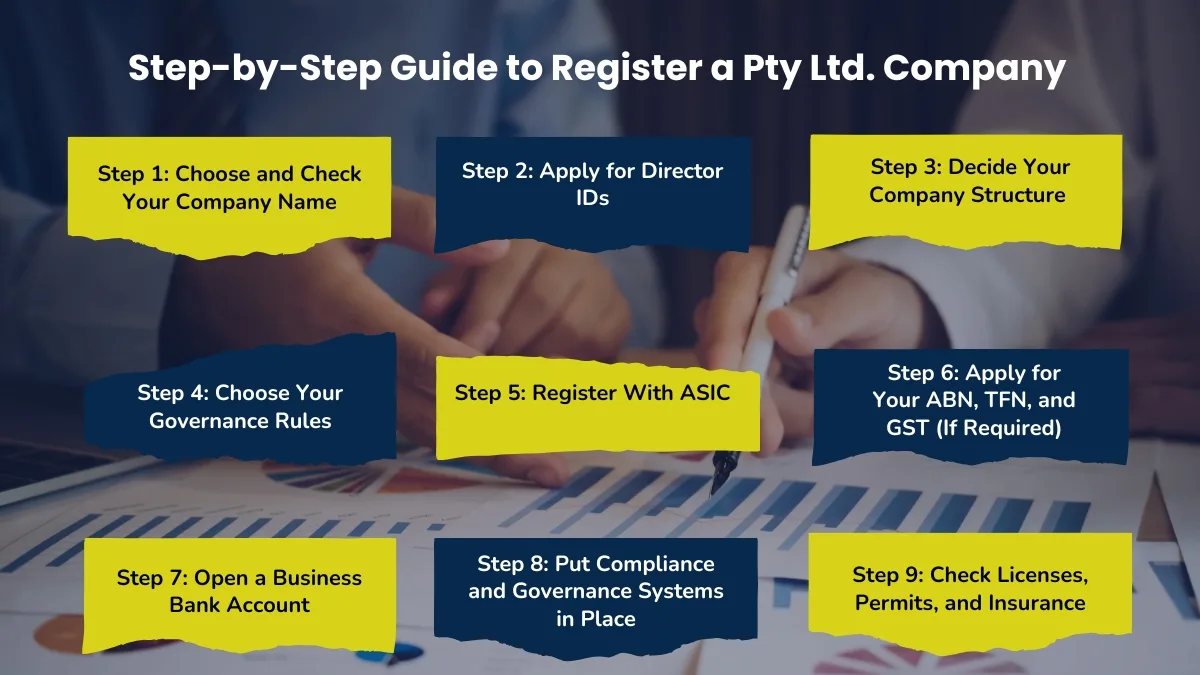
Here’s the full company registration process in Australia, from preparation through to your first weeks of trading.
Step 1: Choose and Check Your Company Name
You’ll want to look through ASIC’s company and business name registers to make sure the name you want is actually available and not some “too close” variation of another existing entity. Your official legal company name (which must end with “Pty Ltd”) doesn’t have to perfectly match the brand name you’ll use in the world, but it’s worth thinking about how those two names will work together day to day.
Recommended Read: Difference Between Business Name and Company Name
Step 2: Apply for Director IDs
Any person who’s going to be appointed as a director needs a Director ID, and that has to be requested via the Australian Business Registry Services before the appointment happens. This part is one-time, and it’s free, though identity checks can take a bit, so start early, like before you “feel ready.”
Step 3: Decide Your Company Structure
Work through who the directors and shareholders are going to be, how shares are split, then lock in your registered office address, plus your principal place of business. Also, remember one director must ordinarily live in Australia, so plan around that requirement.
Step 4: Choose Your Governance Rules
You can go with replaceable rules, a custom constitution, or some mix of both, depending on how much flexibility you want.
Step 5: Register With ASIC
This is the main event in the ASIC company registration process. You’ll lodge an application (Form 201) using the Business Registration Service, and you’ll provide things like
- Company name
- Registered office and principal place of business
- Director and shareholder details, including consents
- Share structure
Once ASIC approves you, it’s often fast, sometimes minutes to a few business days, and then you typically receive
- An Australian Company Number (ACN)
- A Certificate of Registration
- Your company profile in ASIC’s system
Step 6: Apply for Your ABN, TFN, and GST (If Required)
After you get your ACN, you can apply for an ABN and a Tax File Number (TFN). Many people do these tasks in the same session through the Business Registration Service. If you expect turnover of $75,000 or more each year, you’ll usually register for GST, or you can do it voluntarily if that suits your setup.
Step 7: Open a Business Bank Account
Separating personal and business finances isn’t optional for a company it’s a legal and practical necessity. You’ll need your ACN and registration documents on hand to open a business account.
Step 8: Put Compliance and Governance Systems in Place
Set up a share register, keep signed consent forms and corporate records, put document-signing authority (e.g., under section 127 of the Corporations Act) in writing, and calendar your ASIC annual review date and solvency resolution.
Step 9: Check Licenses, Permits, and Insurance
Depending on your industry, you may need council approvals, professional registrations, or sector-specific licenses before you start trading, along with appropriate business insurance.
Need help with ASIC company registration? ISM Accountants can register your Pty Ltd company correctly, help you apply for an ABN and TFN, and ensure you meet all ASIC requirements from day one.
PTY Ltd. Company Requirements Before You Register

Before you begin the ASIC company registration process, ASIC expects you to have several “building blocks” in place. Getting these ready in advance is the single biggest factor in how smoothly your registration goes.
Core Pty Ltd company requirements include:
- A unique company name that is not identical or deceptively similar to an existing company or trade mark. You can check availability and optionally reserve a name with ASIC for a small fee before you’re ready to register.
- At least one director who is at least 18 years old and ordinarily resides in Australia.
- A director identification number (Director ID) for every proposed director this must be applied for before appointment, so don’t leave it until the last minute.
- At least one shareholder (who can also be the director) and up to 50 non-employee shareholders are allowed. You need a registered office address and a principal place of business, both of which must be physical Australian addresses (a PO Box alone won’t satisfy the registered office requirement).
- You must decide on governance: whether to rely on the Corporations Act’s default “replaceable rules,” adopt a custom company constitution, or use a combination of both.
- A share structure: how many shares will be issued, at what value, and to whom.
Not sure if you’ve met all the Pty Ltd company requirements? Speak with ISM accountants before lodging your ASIC application to avoid delays, rejected submissions, and costly mistakes.
What Does It Cost to Register a Company in Australia?
Item | Cost (AUD) | Details & Notes |
Name reservation (optional) | $65 | Reserves a company name with ASIC for up to 2 months. |
ASIC company registration (one-off) | $636 | Statutory fee for registering a standard proprietary company with share capital (Form 201). |
Director ID application | Free | Mandatory for all directors; applied for via Australian Business Registry Services (ABRS). |
ABN and TFN application | Free | This application was submitted through the Australian Business Register (ABR). |
ASIC annual review fee (recurring) | $342 / year | Payable annually on the anniversary of your company’s registration date. |
Key Considerations
- Third-Party / Agent Fees: If you use a private corporate services platform, accountant, or legal provider, they will charge an additional service/processing fee on top of the statutory $636 ASIC fee.
- Business Name vs. Company Name: Reserving a company name ($65) is separate from registering a business name for trading ($47 for 1 year or $108 for 3 years).
- Late Payment Penalties: Missing your annual review payment deadline incurs an automatic ASIC late fee of $102 (up to 1 month late) or $428 (more than 1 month late).
Recommended Read: Who Needs TFN in Australia?
How Long Does Pty Ltd Company Registration Take?
The registration step itself is fast, with many applications approved within minutes to a few business days if submitted correctly. What usually takes longer is the preparation phase: gathering director consents, confirming your address details, deciding on your share structure, and applying for director IDs. Building in a week or two for preparation will make the actual registration feel quick by comparison.
Common Mistakes When Starting a Pty Ltd Company
- Registering a business name instead of a company name: These are different ASIC registers, and confusing them causes delays.
- Leaving Director ID applications until the last minute: This process must be done before the appointment, not after.
- Using a PO Box as the registered office for ASIC requires a physical address.
- Skipping a shareholders agreement when there’s more than one owner: the agreement is separate from your constitution and covers exits, disputes, and share transfers.
- Mixing personal and business finances from day one instead of opening a dedicated business account immediately can lead to complications.
- Forgetting the GST registration threshold: If you expect to cross $75,000 in turnover, register for GST from the outset to avoid backdated liabilities.
Avoid expensive registration and compliance mistakes. See ISM Accountants’ services and how they handle your company setup so you can start your business with confidence.
Final Thoughts
Setting up a Pty Ltd company in Australia is more than just completing an ASIC registration. Choosing the right company structure, meeting all Pty Ltd company requirements, and staying compliant after registration can save you time, money, and legal headaches as your business grows.
By preparing the required information in advance and understanding each step of the process, you can register your company with confidence and build a strong foundation for long-term success. If you’re unsure about any part of the registration process or your ongoing compliance obligations, seeking professional advice can help ensure everything is done correctly from the start.
Ready to start your Pty Ltd company? ISM accountants can manage your ASIC company registration, ABN, TFN, GST registration, and ongoing compliance, so you can focus on growing your business. Contact ISM accountants today to get started.
Frequently Asked Questions
Is Pty Ltd the same as a company in Australia?
Pty Ltd (Proprietary Limited) is the specific type of company structure used by the vast majority of Australian small and medium businesses. Other company types include public companies and companies limited by guarantee.
Can I register a Pty Ltd company myself, or do I need a lawyer?
You can register directly with ASIC through the Business Registration Service without a lawyer. Many founders do this themselves for simple, single-owner setups, while those with co-founders, investors, or more complex share structures often use a lawyer or registered agent to get the constitution and shareholders agreement right.
Do I need an Australian address to register a Pty Ltd company?
Yes, you need a registered office address and principal place of business in Australia, and at least one director must ordinarily reside in Australia.
How much does it cost to register a company in Australia?
The ASIC registration fee is a one-time payment (currently around $636), plus optional costs like name reservation. Ongoing costs include the annual ASIC review fee.
What's the difference between an ACN and an ABN?
Your ACN (Australian Company Number) is issued by ASIC when your company is registered and identifies your company as a legal entity. Your ABN (Australian Business Number) is issued separately by the ATO and is what you use for invoicing, tax, and GST purposes.
What is better, a CC or a PTY Ltd?
A Pty Ltd is better. You can no longer register a new Close Corporation (CC), as CCs have been phased out. A Pty Ltd is the modern standard, offering greater flexibility for raising capital, issuing shares, and scaling your business.