
Missing a tax lodgement deadline happens, but leaving it unresolved is where the real damage begins. Whether you are an individual who forgot to lodge a tax return, a sole trader who got behind on BAS statements, or a company with multiple years of outstanding returns, the Australian Taxation Office (ATO) has a structured and escalating penalty regime that grows the longer you wait.
This guide explains exactly what happens when you have overdue tax lodgements in Australia, what the ATO can do, what the financial penalties look like in real dollar terms, and, importantly, how working with a registered tax agent like ISM Accountants & Advisors in Perth can help you resolve the situation and even have penalties reduced or remitted.
Worried about your overdue tax lodgements? ISM Accountants & Advisors in Perth has helped hundreds resolve theirs, and the sooner you act, the better your outcome. See our services.
TL;DR
Late tax returns and BAS lodgements can result in ATO penalties and interest.
Penalties increase with the length of the delay and depend on the applicable penalty-unit rate.
GIC and Shortfall Interest Charge are no longer tax-deductible from 1 July 2025.
Unpaid tax debts may lead to ATO recovery action.
Lodging overdue returns promptly and contacting the ATO can help minimise further issues.
2026 update: The penalty unit increased to $364 from 1 July 2026.
What Are Overdue Tax Lodgements?
An overdue tax lodgement occurs when you miss the ATO’s required deadline for submitting a tax return, Business Activity Statement (BAS), Fringe Benefits Tax (FBT) return, or another tax obligation. This applies to:
- Individuals (including employees and sole traders) who have not lodged their annual income tax return
- Small and medium businesses with late or missing BAS or IAS lodgements
- Companies, trusts, and partnerships with outstanding annual tax returns
- Self-managed superannuation funds (SMSFs) with missing annual returns
- Employers with overdue Taxable Payments Annual Reports (TPAR)
The key deadlines for most individuals are 31 October each year (if lodging yourself) or the extended lodgement program deadline if you are using a registered tax agent. Missing these dates without prior arrangement with the ATO puts you immediately into overdue territory.
ATO Penalties for Overdue Tax Lodgements: The Full Picture
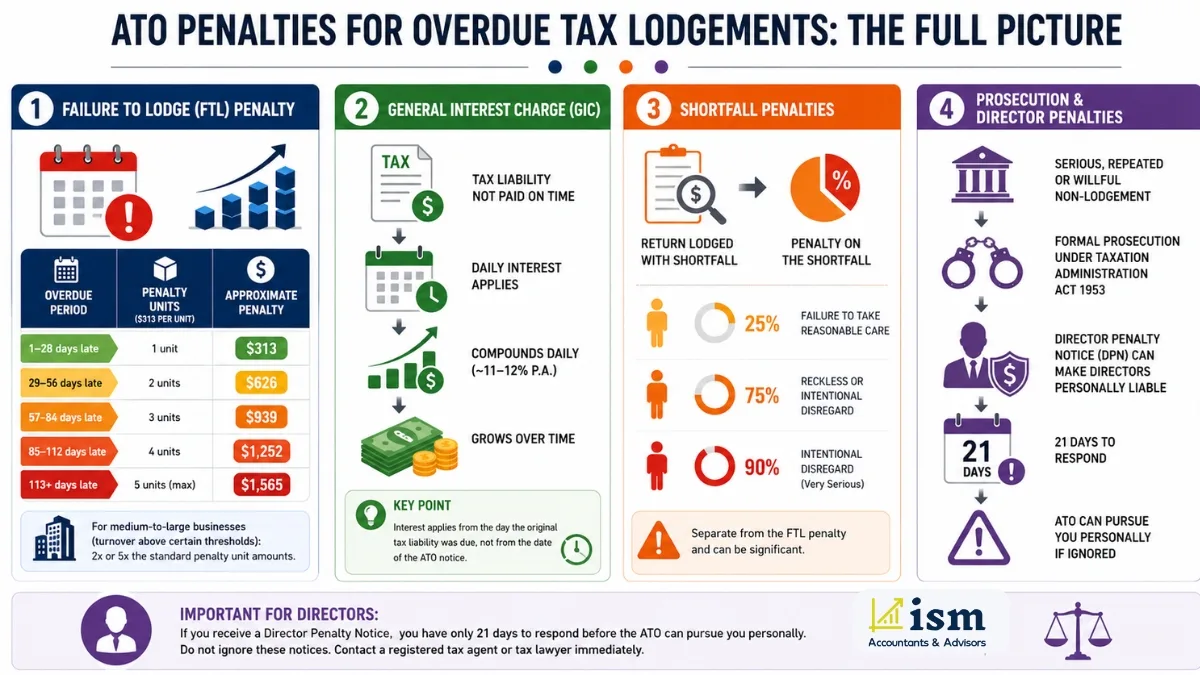
When you miss a tax lodgement deadline, the ATO has a structured penalty system that kicks in immediately and grows the longer you leave it unresolved. Here is a breakdown of every penalty type you could face.
1. Failure to Lodge (FTL) Penalty
The primary penalty for overdue tax returns is the Failure to Lodge (FTL) on-time penalty. This is a period-based penalty that accumulates in units, not a flat fee, meaning the longer you delay, the higher it grows.
The FTL penalty is calculated using a penalty unit, which, from 1 January 2023, is $313 per unit (indexed periodically). One penalty unit is applied for every 28-day period (or part thereof) your lodgement is overdue, up to a maximum of 5 penalty units.
Overdue Period | Penalty Units | Approximate Penalty |
1–28 days late | 1 unit | $313 |
29–56 days late | 2 units | $626 |
57–84 days late | 3 units | $939 |
85–112 days late | 4 units | $1,252 |
113+ days late | 5 units (max) | $1,565 |
Note: For medium-to-large businesses (those with turnover above certain thresholds), the multiplier is 2x or 5x the standard penalty unit amounts.
Recommended Read: How to Register a Trust in Australia?
2. General Interest Charge (GIC)
If your lodgement reveals a tax liability that was not paid on time, the ATO applies the General Interest Charge (GIC) on the outstanding amount. This is calculated daily and compounds; it is not a flat annual rate applied at year-end.
The GIC rate changes quarterly. As of 2024–25, the annual GIC rate is approximately 11–12%, applied daily. On a $10,000 tax debt, this equates to roughly $3 per day in interest accruing from the original due date.
Key Point: GIC applies from the day the original tax liability was due, not from the date the ATO issues a notice. This means a 2-year-old overdue return could already carry 2 full years of compounding interest on top of the FTL penalty.
3. Shortfall Penalties
If your overdue return, once lodged, reveals a tax shortfall, meaning you owe more tax than was paid or withheld, the ATO may also apply a shortfall penalty. These range from 25% of the shortfall (for a failure to take reasonable care) to 75% or even 90% (for intentional disregard). These are separate from the FTL penalty and can be significant.
4. Prosecution and Director Penalties
For serious, repeated, or willful non-lodgement, the ATO can escalate to formal prosecution under the Taxation Administration Act 1953. For company directors, the Director Penalty Notice (DPN) regime can make directors personally liable for unpaid PAYG withholding and superannuation guarantee charges even if the company is insolvent.
Important for Directors: If you receive a Director Penalty Notice, you have only 21 days to respond before the ATO can pursue you personally. Do not ignore these notices. Contact a registered tax agent or tax lawyer immediately.
What Can the ATO Do If You Don't Lodge?
Many people assume that if they don’t lodge, the ATO won’t know. This is a significant misconception. The ATO receives data from banks, employers, share registries, Centrelink, foreign governments, and many other third parties. Their data matching capabilities are extensive. Here is what the ATO can actually do:
- Issue a default assessment the ATO estimates your income based on available data and issues a tax bill. This assessment is legally valid, and you must pay it unless you lodge a correct return.
- Garnish your wages or bank accounts the ATO can legally direct your employer or bank to redirect funds directly to the ATO to recover debt.
- Place a charge or caveat on your property
- Report the debt to credit agencies, affecting your credit rating
- Commence legal proceedings and obtain a judgment debt
- Initiate bankruptcy proceedings for individuals or wind up companies
The ATO does offer assistance programs, but only when you proactively reach out. Waiting for them to contact you puts you in a much weaker position.
Recommended Read: Can ATO Track ABN income?
Common Reasons People Fall Behind on Tax Lodgements

Understanding why overdue lodgements happen can help you take the right steps to address them. Common causes include:
- Life events: illness, family breakdown, death of a spouse or business partner
- Overwhelm from running a small business with incomplete bookkeeping records
- Not realising you were required to lodge (e.g., new migrants, young workers with first jobs)
- Prior accountant or tax agent did not lodge returns on time
- Financial hardship making it stressful to engage with the ATO
- Multiple years of returns falling behind, creating a ‘snowball’ of missed obligations
Regardless of the reason, the ATO generally responds more favorably to taxpayers who come forward voluntarily and with a plausible explanation. This is where having an experienced tax agent on your side makes a material difference.
Can ATO Penalties Be Reduced or Remitted?
Yes, and this is one of the most important things to understand about overdue tax lodgements. The ATO has a formal penalty remission framework, and it does exercise discretion, particularly where:
- The taxpayer voluntarily comes forward before the ATO contacts them
- There are genuine extenuating circumstances (illness, natural disaster, mental health issues, family trauma)
- The taxpayer has a generally good compliance history with no prior defaults
- A registered tax agent makes a formal written application for remission on the client’s behalf
- The taxpayer enters into a payment plan and demonstrates a willingness to comply going forward
The ATO cannot remit penalties automatically; a formal request must be made. This is typically done in writing, accompanied by supporting documentation. Experienced tax agents know how to frame these applications to maximise the chance of a successful outcome.
Pro Tip: GIC remission is also possible in appropriate circumstances, such as serious illness, natural disasters, or where the ATO’s own administrative error caused a delay. Always ask; the worst they can say is no.
Recommended Read: Australian Tax Law for Small Businesses
Step-by-Step: How to Resolve Overdue Tax Lodgements
Resolving overdue tax lodgements can feel overwhelming, but the process is straightforward when you take it one step at a time. Here is the recommended approach to get back on track as quickly as possible.
Step 1: Engage a Registered Tax Agent Immediately
Engaging a registered tax agent like ISM Accountants & Advisors has a key benefit beyond just filing: it extends your lodgement program. Under the ATO’s Tax Agent Lodgement Program, registered agents have extended and staggered deadlines. Engaging an agent now even if you are already overdue can pause or reduce penalty accumulation in some circumstances.
Step 2: Gather Your Records
Compile all income records for the overdue years: PAYG payment summaries or income statements, bank statements, receipts for tax deductions, ABN income records, investment statements, and any ATO correspondence. If records are missing, your tax agent can help retrieve pre-filled ATO data, employer records, and bank data.
Step 3: Lodge All Outstanding Returns
Your agent will prepare and lodge all outstanding returns accurately. It is far better to lodge an accurate return with a tax liability than to delay further or lodge incorrect figures, which can trigger shortfall penalties.
Step 4: Apply for Penalty Remission
Once all returns are lodged, your tax agent will formally apply to the ATO for remission of FTL penalties and, where applicable, GIC charges. This application will outline the circumstances that led to the delay and demonstrate your commitment to future compliance.
Step 5: Arrange a Payment Plan if Needed
If you have a tax liability you cannot pay in full, the ATO offers payment plans (also called payment arrangements). These can be set up online for smaller amounts or negotiated with an ATO officer for larger debts. Your tax agent can negotiate on your behalf to secure a manageable repayment schedule.
Step 6: Set Up Ongoing Compliance
The final step is prevention. Your tax agent will help you establish proper bookkeeping systems, set lodgement reminders, and ensure you never fall behind again. For small businesses, quarterly BAS management by a professional removes the risk entirely.
Recommended Read: Can I Cancel ABN Online?
How ISM Accountants & Advisors Can Help You?

ISM Accountants & Advisors is a registered tax agent and CPA firm based in Perth, Western Australia. Our team has extensive experience helping individuals, sole traders, small businesses, and companies resolve overdue tax lodgement situations, including cases involving multiple years of outstanding returns.
Here is what we do for clients with overdue lodgements:
- Conduct a full review of your ATO lodgement history and outstanding obligations
- Retrieve pre-filled income data and match it with your records to build accurate returns
- Prepare and lodge all outstanding income tax returns, BAS statements, and other obligations
- Write and submit formal penalty remission applications to the Australian Taxation Office (ATO)
- Liaise directly with the ATO on your behalf; you do not need to call the ATO yourself
- Negotiate payment plans for outstanding tax liabilities
- Set you up with an ongoing compliance calendar and bookkeeping support to prevent future issues
We serve clients across the Perth metropolitan area, including Victoria Park, St James, Belmont, Burswood, Rivervale, Cloverdale, Welshpool, Redcliffe, and Lathlain as well as clients throughout Western Australia and Australia-wide for online tax services.
Ready to resolve your overdue lodgements? Contact ISM Accountants & Advisors today for a confidential, no-judgement discussion. The sooner you act, the better your outcome.
Final Thoughts: Act Now, Not Later
Overdue tax lodgements do not get better with time; they get more expensive. Every 28-day period adds another penalty unit, interest compounds daily, and the ATO’s data matching gets more sophisticated every year. The most important thing you can do right now is take action.
Whether you are one year behind or ten years behind, ISM Accountants & Advisors in Perth can help you work through the process professionally, efficiently, and without judgment. We have seen it all, and we know how to get the best possible outcome from the ATO on your behalf.
Still unsure where to start? ISM Accountants in Perth has seen it all, and no matter how far behind you are, there is always a way forward.
FAQs
How many years back can the ATO go for overdue tax returns?
The ATO has no statutory time limit, though it typically pursues returns within the last 5 years with the most urgency. Being proactive can give you more flexibility on older obligations.
What if I think I will owe money? Is it better to just not lodge?
Not lodging is almost always the worse option, as the ATO will issue a default assessment that may be higher than your actual liability. Lodging voluntarily, even late, is always viewed more favorably.
Will the ATO prosecute me for having overdue returns?
Prosecution is reserved for serious and intentional non-compliance involving large amounts or fraud. For most people who fall behind for genuine reasons, the ATO’s priority is simply to get the returns lodged and debt collected.
Can I do a payment plan if I can't pay the tax bill in full?
Yes, the ATO has a well-established payment arrangement system that can be set up online for debts under $100,000. Your tax agent can negotiate directly with the ATO for larger debts.
I haven't lodged for 5+ years. Is it too late?
It is never too late to lodge, and the ATO’s Voluntary Disclosure Service exists precisely for this situation. The sooner you engage a registered agent, the sooner the penalty clock stops.
Does having a tax agent reduce the penalties automatically?
Not automatically, but tax agents know how to make effective penalty remission applications and negotiate with ATO officers. Professionally managed applications consistently achieve better outcomes than self-managed ones.