
Moving to Australia, studying here, or spending a few years working overseas can make your tax situation a little confusing. One of the first things you may need to work out is whether you’re an Australian tax resident or a foreign resident.
The difference can have a real impact on your tax bill. Australian tax residents generally get the $18,200 tax-free threshold and pay tax using resident tax rates. Foreign residents generally don’t get the tax-free threshold and pay tax on Australian-source income from the first dollar at foreign-resident rates. Foreign residents are generally exempt from the Medicare levy for the period they are non-residents. Australian residents usually do, although some people may qualify for an exemption or reduction.
Being an Australian citizen or holding an Australian visa does not, by itself, make you an Australian tax resident. For tax purposes, the ATO looks at what your life actually looks like in Australia. For example, it may consider where you live, how long you’ve been here, where you work, and whether your family and other ties are in Australia.
Your residency status then affects how you are taxed. It can change the tax rates you pay and whether you have to include income from overseas in your Australian tax return. The same rules also matter if you move to Australia or leave the country.
Quick Summary
- Your Australian tax residency is separate from your visa, citizenship or permanent residency status.
- Australian tax residents generally declare worldwide income, although special rules can apply to temporary residents. Foreign residents generally pay Australian tax on their Australian-source income.
- Resident and non-resident tax rates, thresholds and Medicare levy treatment differ significantly.
- The ATO uses several tests (not just a 183-day count) to work out your residency status.
- If you’re unsure where you stand, it’s worth getting tailored tax advice rather than guessing.
What Is an Australian Tax Resident?
An Australian tax resident is someone the ATO considers to have established a sufficient connection with Australia for tax purposes, based on their individual circumstances. Your citizenship or visa status alone does not determine whether you are an Australian tax resident.
The ATO generally considers factors such as:
- Where you live and spend your time
- Your intention and purpose for being in Australia
- Family and personal connections
- Employment or business connections
- Whether you have established a home in Australia
Because residency is based on your circumstances, international students, skilled workers and working holiday makers may be treated as Australian tax residents if their circumstances show a sufficient connection with Australia.
What Is an Non-Resident Australian Tax ?

An Australian tax non-resident, also known as a foreign resident, is someone the ATO does not consider to have established a sufficient connection with Australia for tax purposes. Your citizenship, permanent visa or the amount of time you spend in Australia does not automatically determine your tax residency status.
The ATO considers your overall circumstances when determining whether you are a foreign resident. This can include:
- Where you normally live
- Your intention and purpose for being in Australia
- Your family and personal connections
- Your employment or business connections
- Whether you maintain a home or other significant ties in Australia
Foreign residents are generally taxed in Australia on Australian-sourced income, such as employment income earned in Australia, rental income from Australian property, or certain business income. Unlike Australian tax residents, they are generally not taxed by Australia on income earned entirely from foreign sources, although specific rules and tax treaties may apply.
Recommended Read: Is It Easy to Register a Company in Australia for a Non-Resident?
difference Between Resident and Non-Resident Tax in Australia
Here’s a general comparison of how resident and non-resident tax treatment differs. Actual outcomes depend on your specific circumstances, so treat this as a starting point rather than a final answer.
Area | Australian Tax Resident | Non-Resident (Foreign Resident) |
Tax-free threshold | Generally available ($18,200 per financial year; pro-rata applies if changing residency status mid-year). | Not available (Taxed from the very first dollar earned in Australia). |
Australian source income | Taxed at resident marginal rates starting at 16% (for 2025–26) depending on the current tax brackets). | Taxed at higher foreign resident rates (starting at 30% or 32.5% from the first dollar). |
Foreign income | Taxed on worldwide income (Must declare all income earned outside Australia). | Exempt from Australian tax (Only Australian-sourced income is reportable). |
Medicare levy | Generally applies (Standard 2% of taxable income, subject to low-income thresholds). | Does not apply (Exempt from paying the Medicare levy). |
Capital gains tax | Applies to all worldwide assets. Eligible for the 50% CGT discount on assets held for over 12 months. | Only applies to Taxable Australian Property (e.g., local real estate). Generally not eligible for the 50% discount or Main Residence Exemption. |
Tax rates differ significantly between Australian residents and foreign residents. Australian residents generally receive the $18,200 tax-free threshold and are taxed at progressive rates. Foreign residents generally do not receive the tax-free threshold and are taxed from the first dollar of Australian taxable income at foreign-resident rates.
These figures can change from year to year, so it’s worth confirming current rates with the ATO or a tax professional before relying on them for planning.
For the 2025–26 financial year, the standard resident tax rates are:
Taxable income | Resident tax rate |
0–18,200 | Nil |
18,201–45,000 | 16% |
45,001–135,000 | 30% |
135,001–190,000 | 37% |
$190,001+ | 45% |
For the 2025–26 financial year, foreign resident tax rates are:
Taxable income | Foreign resident tax rate |
0–135,000 | 30% |
135,001–190,000 | 37% |
$190,001+ | 45% |
Note: Tax rates changed from 1 July 2026, so rates for the 2026–27 financial year are different.
Recommended Read: Tax Deductions You Can Claim Without a Receipt in Australia
Resident vs Non-Resident Tax: Practical Examples
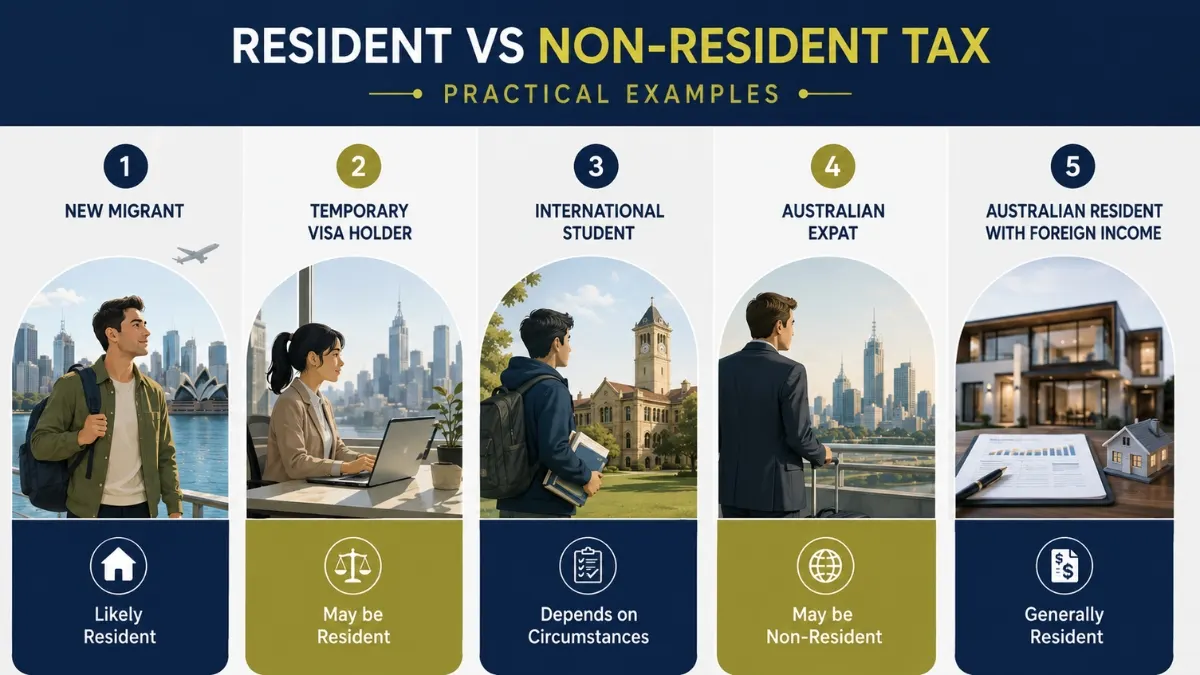
These are general illustrations; only actual residency status depends on the relevant tests and each person’s full circumstances.
- New migrant
Arrives with the intention to settle permanently, likely to become a resident from around the time they establish their life here. - Temporary visa holder
On a multi-year skilled visa with a rental lease and local job, may be a resident depending on their broader connections. - International student
Studying a multi-year degree and living in shared accommodation, residency depends on intention and living arrangements, not visa type alone. - Australian expat
Working overseas long-term with no Australian home, may become a foreign resident, subject to their specific facts. - Australian resident with foreign income
Living in Australia year-round with overseas rental income, generally still required to declare that income as a resident.
Recommended Read: How to Reduce Your Taxable Income Legally
Common Australian Tax Residency Mistakes
Working out your tax status can get messy, and it is easy to rely on assumptions that catch people off guard. Here are a few common misunderstandings to watch out for:
- “I’m not an Australian citizen, so I’m automatically a non-resident.”
Not true. Citizenship isn’t the deciding factor, your everyday life, housing, and routine matter much more than the passport you hold.
- “I have a temporary visa, so I can’t possibly be a tax resident.”
Temporary visa holders (like skilled workers or students) can still be classified as tax residents if their main life and connections are rooted here.
- “I stayed for 183 days, so that automatically makes me a resident.”
The 183-day rule is only one piece of the puzzle, not a hard automatic switch. The ATO always looks at your overall lifestyle and intentions first.
- “I moved overseas, so I immediately became a non-resident.”
Simply boarding a flight doesn’t change your tax status overnight. It depends on whether you have truly cut your physical and economic ties to Australia.
- “Non-residents don’t pay any Australian tax at all.”
Foreign residents still have to pay tax on anything they earn inside Australia, such as local job wages or rental income from local property.
- “I only need to declare income earned inside Australia.”
That only applies if you are genuinely a foreign resident. If you are an Australian tax resident, you are legally required to declare your worldwide income on your return.
Not sure whether your visa or living situation makes you an Australian tax resident? ISM Accountants can help you work through the relevant tests and confirm your position.
How Do You Determine Your Australian Tax Residency?
The ATO uses several residency tests. You generally only need to satisfy one of these tests to be considered an Australian resident for tax purposes.
- The Resides Test: This looks at whether you actually “reside” in Australia in the ordinary sense where you live, how long you’ve been here, your intentions, and your family, social and employment connections. It’s the most commonly applied test and considers your overall circumstances rather than one single factor.
- The Domicile Test: This test generally considers your legal “domicile”, often your country of origin or permanent home unless the ATO is satisfied you have a permanent place of abode outside Australia. It’s particularly relevant for Australians who have moved overseas.
- The 183-Day Test: Many people assume that spending 183 days or more in Australia in an income year automatically makes them a tax resident. That’s a common misconception. The 183-day test can be relevant, but spending 183 days in Australia does not automatically make you an Australian tax resident. The specific conditions of the test and your overall circumstances matter.
- The Commonwealth Superannuation Test: This test is quite narrow. It generally applies to certain Australian government employees working overseas and their families, rather than to the general public.
How Does Tax Residency Affect Your Foreign Income?
This is one of the areas where the difference between resident and non-resident status really matters.
Australian tax residents generally need to declare their worldwide income, although special rules apply to temporary residents and certain types of foreign income.
Foreign residents, by contrast, generally only need to focus on Australian-source income.
If you’re a resident with foreign income that’s already been taxed overseas, Australia’s foreign income tax offset may help reduce the risk of being taxed twice on the same income, depending on your circumstances and any relevant tax treaty.
Get Help With Your Australian Tax Residency
Working out whether you’re a resident or non-resident for tax purposes isn’t always straightforward, especially if you’ve recently moved countries, hold a temporary visa, or have income from more than one place.
ISM Accountants, based in Perth, helps individuals across Australia understand their tax residency position and meet their obligations correctly whether that’s an individual tax return, advice on foreign income, or a broader review of your tax residency status.
If you’re unsure where you stand, book a consultation with ISM Accountants to get clarity on your specific situation.
Final Thoughts
Resident and non-resident tax status in Australia comes down to your actual circumstances not your visa, citizenship or a simple day count. The difference affects your tax rates, whether you get the tax-free threshold, and whether you need to declare income earned overseas.
If you’re not confident about your Australian tax residency, it’s worth getting advice tailored to your situation rather than assuming based on general rules of thumb. You can contact ISM Accountants to know more about resident vs non resident tax in Australia.
Frequently Asked Questions
How do I know if I am an Australian tax resident?
It depends on applying the relevant residency tests to your individual circumstances, including where you live, your intentions, and your connections to Australia. There’s no single factor that decides it on its own.
Can a temporary visa holder be an Australian tax resident?
Yes, depending on their living arrangements and connections to Australia, a temporary visa holder can be treated as a tax resident.
Do non-residents pay tax in Australia?
Yes. Foreign residents generally pay tax on income sourced in Australia, even though they’re not taxed on foreign income.
Do Australian tax residents pay tax on overseas income?
Generally, yes. Australian tax residents are typically required to declare worldwide income, subject to certain offsets and treaty provisions.
Do foreign residents get the tax-free threshold?
Generally, no. Foreign residents are typically taxed from the first dollar of Australian source income.
Does 183 days automatically make me a tax resident?
No. While the 183 day test can be relevant, it isn’t automatic and depends on other factors, including your usual place of abode.