
You can claim up to $300 in total work-related expenses without providing formal receipts. That’s the basic limit under the Tax Claim without Receipt rules.
If you go beyond that amount, there are still a few specific record‑keeping exceptions. For example, you can claim up to $150 for laundry expenses. And if you use your car for work, you’re allowed to claim up to 5,000km at 88c per km without invoices. These fall under allowable tax claims without proof, but that doesn’t mean you can just estimate randomly. You still need to show that the expense actually happened.
This is where people often get confused. Tax deductions without a receipt are allowed in certain situations, but you’re still expected to follow ATO rules on missing receipts. The tax office wants proof that the money was spent, just not necessarily a paper receipt in every case.
If you’re unsure about what qualifies or how much you can safely claim, getting advice from a tax professional is honestly the safest move. ISM Accountant is a Perth-based tax agent helping many businesses and professionals manage their tax correctly and avoid unnecessary trouble.
What is Tax Claims Without Receipts?
Tax claims without receipts just means you can claim work or business expenses even if you don’t have the actual receipt. It happens, maybe you lost it or never got one. A lot of Australians get confused about what counts as proof.
The ATO does allow some alternatives:
- You don’t always need a receipt. Things like bank statements, digital invoices, a work diary, a logbook, or even email confirmations can work.
- The expense has to be real and needed for work or your business, not personal stuff.
- There are limits for small or tricky expenses, like laundry, minor purchases, car costs, or home office stuff.
So basically, it’s about showing the expense really happened, even if you don’t have a piece of paper to prove it.
Does the ATO actually ask for receipts?
Yes. The ATO can audit your tax return and request proof of any deduction. However, for claims below certain thresholds, like the $300 general work-related expense limit, or for expenses that are hard to document, keeping a diary, logbook, bank statement, or electronic evidence is usually sufficient to substantiate your claim.
Example:
If you bought pens or notebooks for work totaling $50 and lost the receipts, you can still claim them as long as you have a diary entry or bank record showing the purchase.
Tip: Always keep a consistent record of minor or recurring expenses, it makes claiming without receipts easier and strengthens your position during an audit.
The $300 General Work-Related Expense Rule

In Australia, the $300 general work-related expense rule is the go-to for claiming small work expenses without receipts. Basically, it gives employees a safety net if they’ve spent money on legitimate work stuff but don’t have a receipt to show for it.
Quick Facts:
- If your total work-related expenses are $300 or less, receipts aren’t needed.
- Expenses must be:
- Actually incurred
- Directly related to your work
- Reasonably calculated
Watch out for the $301 Trap: If your expenses go over $300, you need receipts for the entire amount, not just the bit over $300. This is often called the $301 trap, and missing this can catch the ATO’s attention.
Examples of Eligible Expenses Under $300:
- Stationery (pens, notebooks, printer paper)
- Small tools or equipment
- Casual work items like protective gloves or low-cost safety gear
Tip for Claiming Without Receipts: Keep a diary, logbook, or bank statement showing the purchase date, amount, and supplier. Even tiny things like coffee for work meetings or cheap office supplies can be claimed if you have some form of proof.
Can I claim under $300 without receipts?
Yes. As long as the expense is real, work-related, and backed up with something like a diary or bank statement, the ATO lets you claim it without a physical receipt.
Recommended Read: Work Clothes & Laundry Tax Deduction Perth
List of Expenses You Can Claim on Tax Without a Receipt

In Australia, you can claim certain work-related expenses even if you don’t have a receipt. You just need some kind of proof, like a diary, logbook, bank statement, or digital evidence. The key is that the expense is genuine, job-related, and follows ATO rules.
1. General Work-Related Expenses (Under $300)
If your total work-related costs are $300 or less, you don’t need a receipt. That includes things like stationery, pens, notebooks, printer paper, minor tools, or casual work items. Just keep a diary or a bank record to show when and what you bought. Even small stuff like printer paper or pens counts.
2. Laundry Expenses (Up to $150/year)
This covers washing, drying, or ironing work uniforms or protective clothing. You can claim $1 per work-only load and 50 cents per mixed load. Remember, laundry counts toward your $300 general limit. A simple diary noting the loads and dates is enough proof. So yes, even if you don’t keep receipts for every uniform wash, you can still claim it.
3. Small Expenses & Protective Gear (Under $10 / Up to $200/year)
Minor office supplies, small tools, or protective clothing like gloves or hats can be claimed too. Keep a log of the supplier, date, amount, and purpose. It doesn’t have to be fancy, just enough to show the purchase happened. Small purchases add up, so don’t skip claiming them.
4. Car Expenses – Cents-per-Kilometre Method
You can claim up to 5,000 km per year without receipts at 88 cents per km (2025–26 rate). Just maintain a diary or logbook showing dates, purpose, and kilometres travelled. This works great if you’re driving between clients or job sites. It’s an easy method for small business owners or remote employees.
You might like to read: Four Mistakes To Avoid While Buying a Car
5. Home Office & Utilities – Fixed Rate Method
If you work from home, you can claim 70 cents per hour for things like electricity, gas, phone, internet, stationery, and small computer consumables. Keep a diary, timesheet, or roster of hours worked instead of holding onto every receipt. Perfect for freelancers, remote workers, or anyone working from home.
6. Hard-to-Get or Miscellaneous Expenses
Expenses like parking meters, tolls, vending machines, or public transport tickets can be claimed too. Just note the date, amount, and purpose in a diary or log. The ATO accepts these as alternative evidence.
7. Union & Professional Fees
Union memberships or professional subscriptions are easy. Usually, these show up pre-filled on your PAYG summary or income statement, so you don’t need extra receipts.
8. Digital & Electronic Evidence
Photos, scans, email confirmations, or PDF invoices all work as proof, as long as they clearly show the date, supplier, and amount. Keeping consistent digital records makes your claim safer and lowers audit risk.
Key Takeaways:
- Always keep some kind of record, even if you don’t have receipts.
- Diaries, logbooks, bank statements, or digital confirmations all work.
- Know the limits: $300 general, $150 laundry, $200 for minor items.
- With proper record-keeping, claiming expenses without receipts is easy, safe, and audit-ready.
Recommended Read: Claiming Self Education Expenses in Tax Returns
What are the Accepted Substitutes for Receipts?
Even if a receipt is lost or never existed, the ATO still lets you back up your Tax Claim without Receipt with alternative proof. Using these substitutes keeps your deductions valid and audit-ready.
Alternative Proof | How It Works | Notes |
Bank / Credit Card Statements | Shows the amount, date, and supplier | Must clearly relate to the expense; great for minor or recurring expenses |
Digital Evidence | Emails, photos, scanned receipts, PDFs | Must be verifiable and accurate; apps like myDeductions make it easier |
Income Statements / PAYG | Union fees, professional subscriptions | Already documented; no extra receipts needed |
Work Diaries / Logbooks | Useful for car, laundry, or small expenses | Record date, purpose, and cost to stay audit-compliant |
Pro Tips for Claiming Without Receipts:
- Keep a consistent log of minor or recurring expenses, this really helps when claiming expenses without receipts.
- Use digital tools or apps to organise records. Photos, PDFs, and emails are accepted by the ATO more and more.
- Even without receipts, a well-kept diary or logbook works for home office, car travel, laundry, and small expense claims.
- Example: Bought pens, stationery, or paid for a parking meter in cash? Just jot down the date, amount, supplier, and purpose in your diary. That’s enough for a tax deduction no receipt claim.
Recommended Read: Departing Australia Super Annuation Claim
What Types of Proof Are Not Accepted for a Tax Claim Without a Receipt?
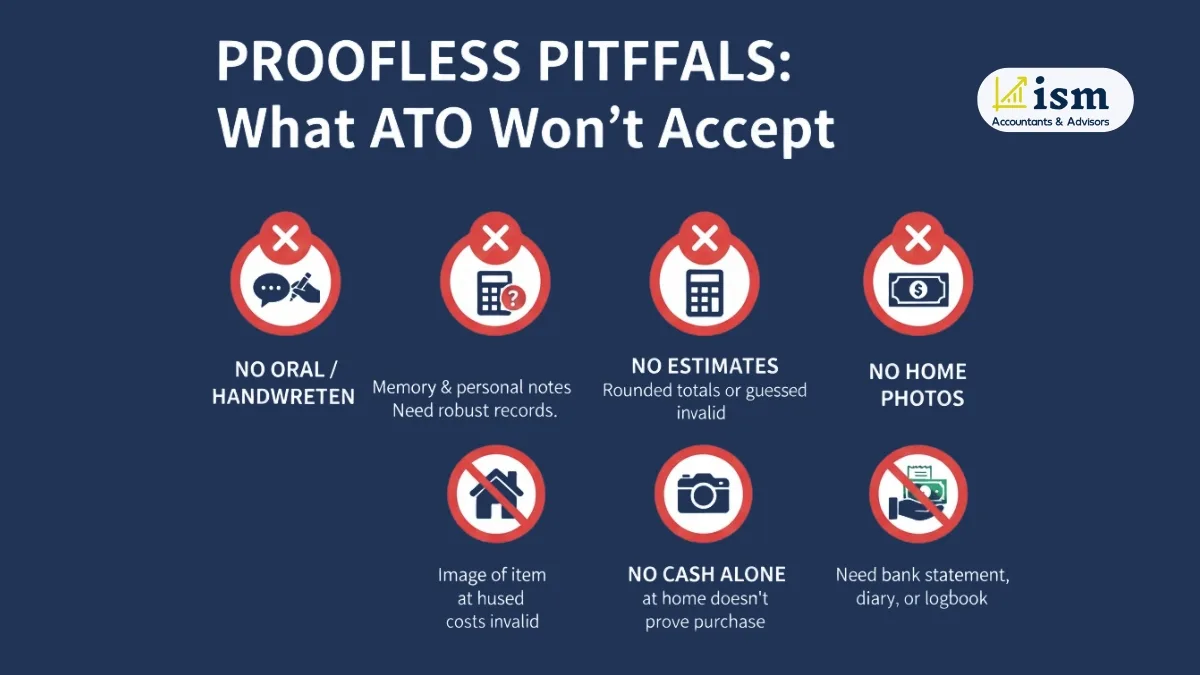
Even though the ATO gives some wiggle room for Tax Claim without Receipt, there are definitely things you can’t get away with. Knowing this stuff keeps you out of trouble and stops audits from coming knocking.
Here’s what won’t fly:
- Handwritten notes or oral claims – The ATO isn’t interested in your memory or what you tell them verbally.
- Estimated amounts or rounded totals – You can’t just guess costs or round numbers up to make life easier.
- Photos of items at home – Taking a picture of a product doesn’t prove you actually bought it.
- Cash payments without proof – Paying in cash alone isn’t enough. You need a bank statement, diary, or logbook showing the expense was work-related.
Pro Tip: Even small stuff matters. Keeping a diary, logbook, or digital record makes your tax claim without receipt legit, compliant, and safe if the ATO ever asks.
How to Claim Expenses Without Receipts?
Claiming tax deductions no receipt isn’t as scary as it sounds. If you follow a few simple steps, it’s actually pretty straightforward.
Step 1: Identify Eligible Expenses
- General work expenses: Up to $300
- Minor items: Under $10 each, up to $200/year
- Special categories: Laundry, car travel, home office
Tip: Only claim genuine, work-related expenses that fall within ATO limits. Don’t try to fudge it.
Step 2: Keep Alternative Evidence
Use whatever proof you have: bank statements, digital receipts, emails, or even a diary/logbook. Make sure to note the date, supplier, and amount.
Pro Tip: Apps like myDeductions make keeping digital records much easier.
Step 3: Maintain a Work Diary
Track your car trips, laundry, uniforms, and small purchases. Include the date, purpose, and cost. Diaries are actually accepted by the ATO as valid proof, so they’re super handy for claiming expenses without receipts.
Step 4: Apply Fixed Rates
- Home office: 70c per hour
- Car travel: 88c per km using the cents-per-kilometre method
- Laundry: $1 per work-only load, 50c for mixed loads
Using these fixed rates makes life easier and can help you get the most out of your allowable tax claims without proof.
Step 5: Use Tracking Tools
Automate as much as you can with accounting or expense software. These tools generate reports that make supporting your claims way simpler during audits. Digital records also make sure you don’t miss anything you could claim.
Recommended Read: Xero vs Myob vs Quickbooks
Final Thoughts
Claiming tax deductions no receipt is honestly not as tricky as it sounds, once you keep good records and stick to the ATO-approved ways. Diaries, logbooks, bank statements, or even digital evidence can all back up your claims. Do it right, and you can confidently claim legitimate work expenses, get the refund you deserve, and stay completely compliant.
If you want some expert help to make the whole process stress-free, reach out to ISM Accountants. They’ll guide you through everything and make sure your Tax Claim without Receipt is smooth and hassle-free.
FAQs
Yes. You can claim minor work-related expenses under $10 each, up to $200 per year, without physical receipts. You must keep a diary, logbook, or bank record showing the date, supplier, amount, and purpose of the expense.
The ATO accepts alternative evidence such as:
- Bank or credit card statements showing the purchase
- Digital receipts or email confirmations
- Work diaries or logbooks for travel, laundry, or small purchases
Yes. If your claims exceed the allowed limits or cannot be substantiated with alternative proof, the ATO may reduce your deduction, impose penalties, or audit your return. Keeping clear records avoids these risks.
Absolutely. Scanned receipts, emails, PDFs, or photos are valid proof as long as they clearly show the date, supplier, and amount. Using apps like myDeductions makes it easier to organize digital evidence.
Yes. Under the fixed-rate method, you can claim 70 cents per hour for home office use in 2025–26 without utility bills. You must maintain a diary or timesheet showing hours worked from home.
Yes. The ATO may audit your deductions, even if under thresholds like $300 for general work expenses. Proper alternative evidence such as logbooks, diaries, or digital records is sufficient to substantiate your claim.
Yes. For car travel using the cents-per-kilometre method, you can use bank or credit card statements to prove fuel or travel costs, but you should also maintain a diary or logbook showing dates, purpose, and kilometres travelled for full compliance.