

Yes, you can register a company in Australia as a non-resident. And the process is simpler than most people expect. ASIC registration is 100% online and fast. Most applications get approved within 24 to 48 hours. No trips to Australia required, no local partner needed, and no minimum capital to put in.
But here’s what most guides skip: you can’t register a Pty Ltd without at least one director who actually lives in Australia. That one requirement is where things get complicated, especially if you’re a solo offshore founder with no local contacts on the ground.
So the real picture:
- Administratively effortless. Digital, fast, and straightforward.
- Logistically, it’s harder than it looks. The director requirement, banking, and ongoing compliance are where people struggle.
Think of it like booking a flight. Clicking “buy” takes two minutes. Actually getting through customs, finding your hotel, and navigating a new country that’s a different story.
The good news? With the right support, it’s absolutely doable. The rest of this guide covers exactly what you need, what it costs, and where the real challenges are.
Quick overview of registering a company in Australia from overseas
- You don’t need to visit Australia to register a company.
- ASIC approval usually takes 24–48 hours after submission.
- You need a nominee director if you don’t have a local contact.
- Director ID for non-residents may require a manual paper application, which takes longer.
- You’ll receive an ACN (Australian Company Number) after registration.
- Tax setup includes ABN, TFN, and GST (if required).
- Opening a traditional bank account may require an in-person visit.
- Compliance includes ASIC annual reviews, BAS lodgements, and tax returns.
- Missing compliance deadlines can lead to fines and penalties.
- A Pty Ltd (subsidiary) is usually safer than a branch office due to limited liability.
The 3 Mandatory Requirements for Non-Residents to register a company in australia
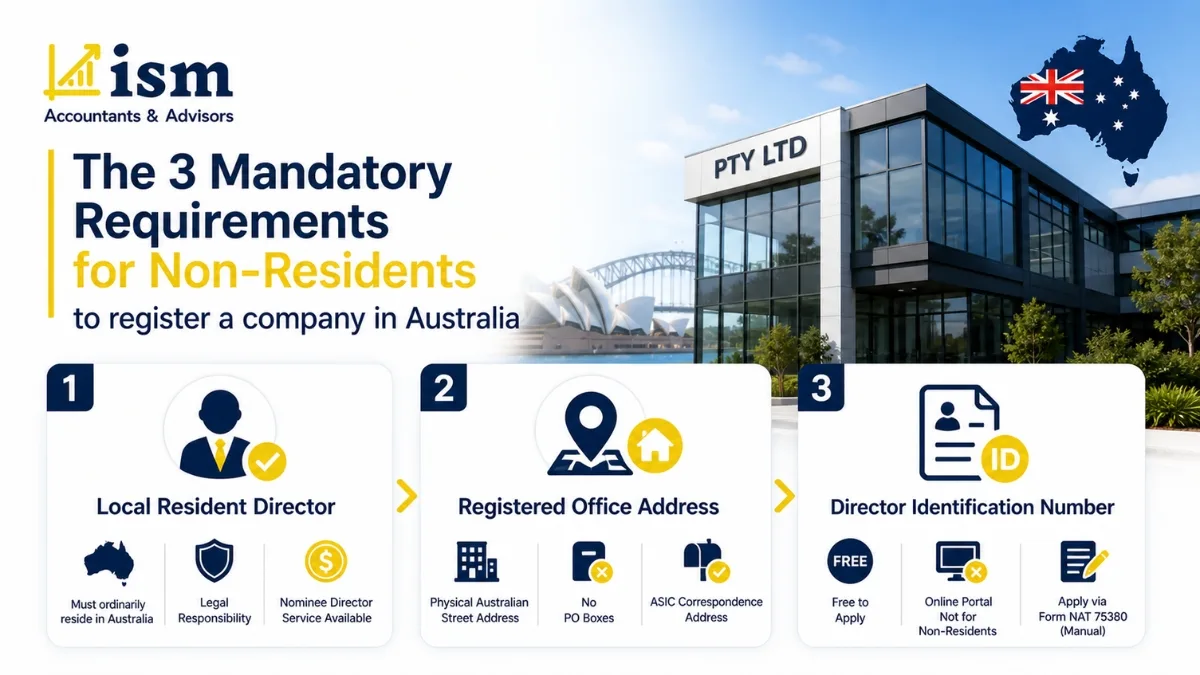
Registering a company in Australia is straightforward, but only if you meet the three core requirements first. These form the foundation of your application, and without them, the process simply won’t move forward.
1. Local Resident Director
Every proprietary limited company in Australia must have at least one director who “ordinarily resides” in Australia. No exceptions.
If you’re overseas, the standard solution is a nominee director service, a professional who fills this legal role on your behalf. It works, but it costs money and requires trust. Don’t just grab the cheapest option you find online this person carries real legal responsibility for your company.
2. Registered Office Address
You need a physical Australian street address for all ASIC correspondence. No PO Boxes. Most nominee director providers bundle a registered office address into their package, so you can usually knock both out together.
3. Director Identification Number (Director ID)
Every director needs one before the company can be registered. It’s free, but here’s the part most guides skip: non-residents usually can’t use the online portal. You’ll need to submit a manual paper application using Form NAT 75380, which takes longer. Factor this delay into your timeline from day one.
Need help with business structure or long-term planning? Our ISM Accountants business advisory service helps non-residents make the right decisions from day one.
Can You Start a Business in Australia on a Student Visa?
Yes, but there’s a clear line between what’s allowed and what isn’t.
You can own shares, hold a directorship, set up an ABN, and earn passive business income. You can also hire staff to handle day-to-day operations while you manage things from a supervisory role.
You can’t actively work in the business full-time. Student visas cap work at 48 hours per fortnight. If you’re running the business like a full-time job, you’re likely breaching your visa conditions. The Department of Home Affairs does monitor this penalties include visa cancellation and re-entry bans. So yes, ownership is fine. Just be careful about how hands-on you get operationally.
Step-by-Step: How to Register Company in Australia From Overseas?
- Step 1: Choose your structure. For most non-residents, it’s a straight choice between a subsidiary (Pty. Ltd.) and a branch office (foreign company registration). The Pty. Ltd. limits your personal liability. The branch office doesn’t know you’re exposed. The Pty Ltd is the better choice unless you have a very specific short-term reason to choose a branch.
- Step 2: Get your identity documents sorted. You’ll need certified copies of your passport and utility bills, notarized in your home country. Get this done early it’s often the slowest part of the whole process.
- Step 3: File with ASIC by submitting Form 201 through a registered ASIC agent. Approval usually takes 1–2 business days. Once approved, you’ll receive your ACN (Australian Company Number), your company’s permanent identifier.
- Step 4: Set up your tax registrations. Apply for your ABN (Australian Business Number) and TFN (Tax File Number) through the ATO. If your projected turnover exceeds $75,000, add GST registration too. You can submit these at the same time as your ASIC application to save time.
Want someone to handle all of this without the back-and-forth? ISM Accountants manages new business registration.
What Does It Actually Cost?
Item | Estimated Cost (AUD) |
ASIC Registration Fee | ~$611/year |
Nominee Director | $3,000 – $6,000/year |
Virtual/Registered Office | $50 – $100/month |
Accountant / Tax Setup | $500 – $2,000 |
Total First Year | ~$4,500 – $9,000+ |
Honestly, the nominee director fee is what surprises most people. It’s the biggest single cost, and most guides quietly understate it. Budgeting for quality, a bad nominee arrangement creates real liability that’s expensive to undo.
If you need help understanding your full tax position from the start, our taxation services cover exactly that.
What Makes Company Registration in Australia Difficult for Non-Residents?

Banking is harder than expected: Opening a traditional Big 4 bank account (ANZ, CBA, NAB, or Westpac) usually requires an in-person visit. That’s a real problem if you’re setting up remotely.
The practical fix: neobanks and fintechs. Wise Business and Airwallex both enable remote onboarding and are designed for exactly this situation. Still allow 2–6 weeks and have your ASIC certificate, ABN confirmation, Director ID, and proof of identity ready before you start.
Compliance has strict deadlines: Annual ASIC reviews, BAS lodgements, and income tax returns these don’t move for anyone. Missing them means fines. If you want clean books from day one without the stress, our bookkeeping service keeps everything on track year-round.
Are you already behind on a previous period? Our overdue tax return service sorts you out before penalties compound further.
What Makes Company Registration in Australia Easy and What Makes It Difficult?
Why It’s Easy | The Difficult Parts |
Fully online ASIC application | Must find a local resident director |
No minimum capital required | Traditional banking requires in-person visit |
Fast approval (1–2 business days) | Nominee director costs add up |
100% foreign ownership allowed | Tax filing is complex for non-residents |
Final Thought
Registering is the easy part. Everything around it finding a reliable director, navigating banking, and staying compliant is where it gets real. If you’ve got a local partner already, the process is genuinely straightforward. If you’re going in 100% offshore, it’s absolutely doable, but you need the right support in place from day one. Doing it wrong doesn’t just cause stress. It costs real money to fix, and occasionally it means starting completely over.
Don’t let that be your story.
Ready to set up your Australian company the right way? Contact ISM Accountants today. We’re a registered ASIC agent and CPA firm, and we handle the full setup so you don’t have to figure it out alone.
Frequently Asked Questions
Can a non-resident register a company in Australia?
Yes. You need at least one Australian resident director, a physical registered address, and tax registrations, including an ABN and TFN.
What is the cost of a nominee director in Australia?
The market average is $3,000 to $6,000 AUD per year. Price varies by provider don’t just go with the cheapest. The nominee carries real legal responsibility for your company.
How do I get an ABN as a non-resident?
Apply through the ATO at the same time as your ASIC registration. You’ll need your ACN, Director ID, and relevant tax details. Our team can handle the application as part of your full company setup.
What's the difference between registering a subsidiary vs. a branch office in Australia?
A subsidiary (Pty. Ltd.) limits your personal liability. A branch office doesn’t your home company is fully exposed. For almost all non-residents, the Pty. Ltd. is the smarter, safer structure.
How do Indian, US, or UK residents register an Australian company?
The process is the same regardless of your home country. You need a local resident director, a registered Australian address, and a director ID. The main variable is identity verification some countries require extra notarization steps.
Do I need to visit Australia to register?
No. ASIC registration is fully online. Banking with a traditional bank usually requires an in-person visit, but neobanks like Wise Business and Airwallex offer remote onboarding.
What is a director ID, and how do non-residents apply?
A director identification number is mandatory for all directors. Non-residents typically can’t use the online ABRS portal and must submit Form NAT 75380 as a paper application. Allow extra time it can take longer than the online process.