
Aged care workers are among the most underclaimed professions at tax time, and it costs them real money every year. If you work in aged care, there’s a good chance you’re spending money out of your own pocket to do your job, and most of it is claimable.
Uniforms, travel, training, phone bills, and protective equipment – it all adds up over the year. The problem is, a lot of aged care workers either don’t know what they can claim or they claim the wrong things and end up with the ATO asking questions. Neither situation is great.
This checklist walks you through everything you need to know about aged care worker tax deductions: what’s allowed, what’s not, and how to make sure your records are solid enough to back it all up.
Not sure what you’re entitled to claim this year? Book a free consultation with ISM Accountant and our tax specialists will make sure you don’t leave money on the table.
Aged Care Worker Tax Deductions at a Glance
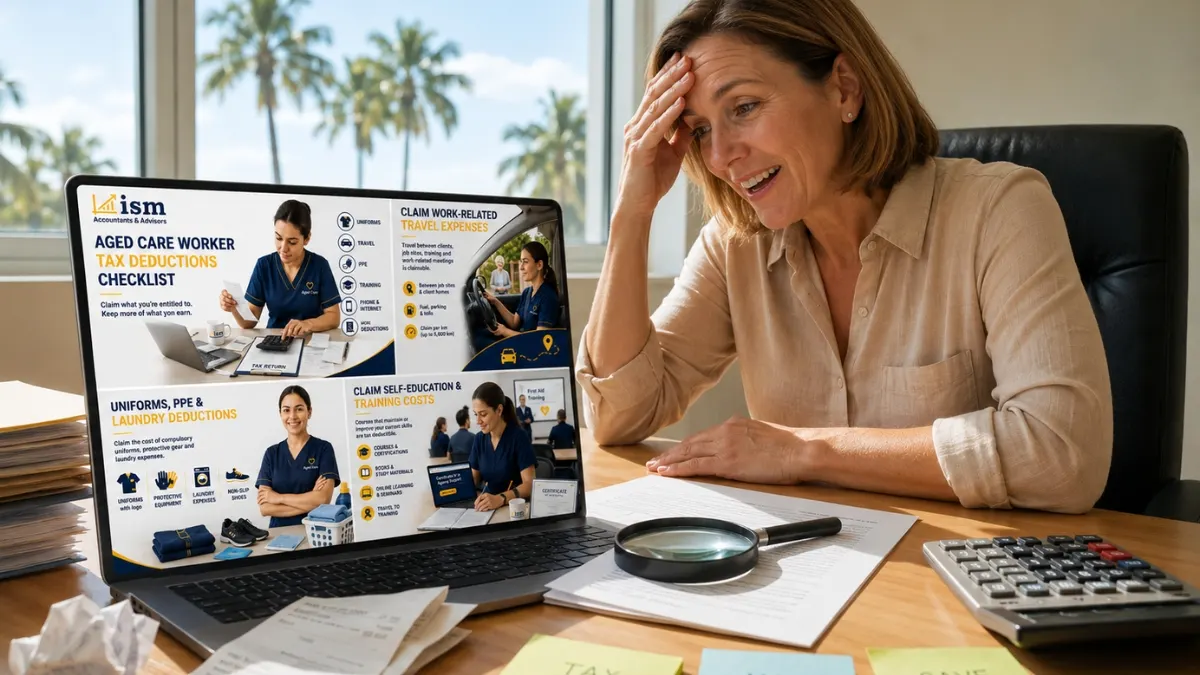
- Uniforms with your employer’s logo, PPE, and laundry costs are claimable
- Car travel between job sites, client homes, and work-related training qualifies
- Self-education courses that improve your current aged care skills are deductible
- Work tools under $300 can be claimed in full; over $300 are depreciated
- Claim the work-related percentage of your phone and internet bills
- Union fees, license renewals, and professional memberships are straightforward claims
- Income protection insurance premiums are tax-deductible
- Your daily commute, plain clothing, personal grooming, and regular meals are not claimable
- Keep digital records: photos of receipts, invoices, and bank statements all count
- Lodge by 31 October or use a registered tax agent for an extended deadline
The Three ATO Rules That Apply to Every Deduction
Before getting into the specifics, the ATO has three conditions that apply to every deduction you want to claim on your aged care worker tax return:
- You must have paid for it yourself, not your employer
- It must be directly related to earning your income
- You must have a record to prove it (receipt, invoice, bank statement)
If an expense ticks all three boxes, you’re generally good to go. If it misses even one, don’t claim it. Simple as that.
Full Aged Care Tax Deduction Checklist
There are more claimable expenses than most aged care workers realise. Work through each category below and note anything that applies to your situation.
Uniforms and Protective Clothing
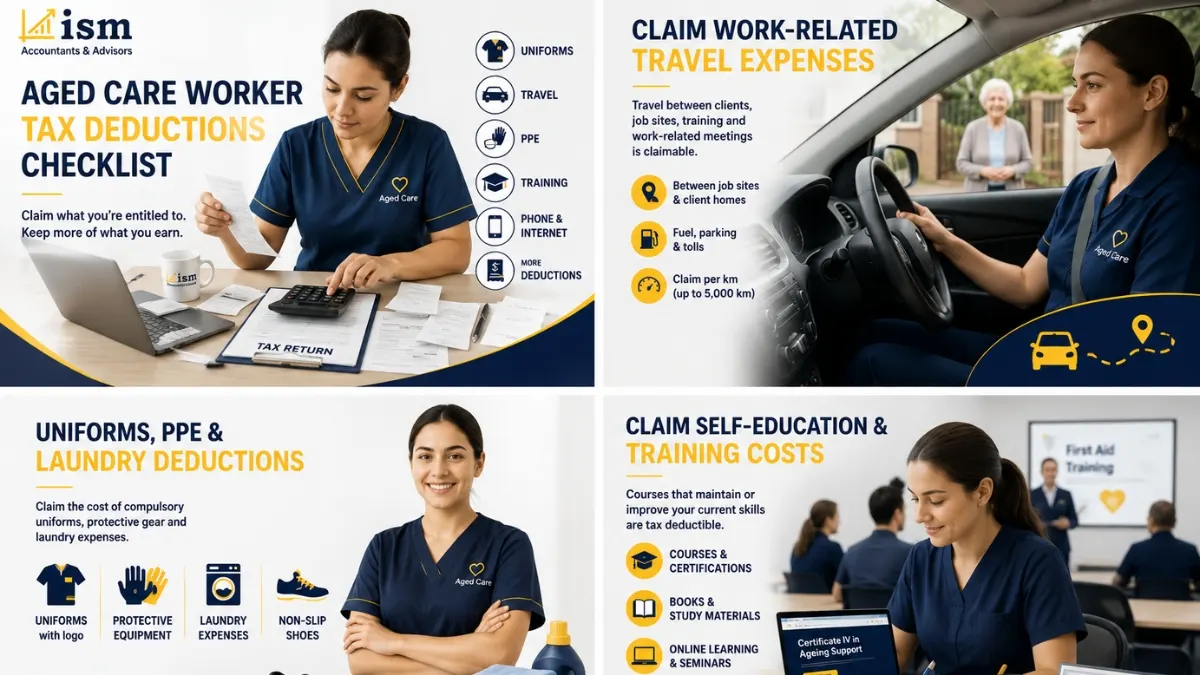
You can claim compulsory uniforms that carry your employer’s official logo, plus costs to repair or replace them. Protective gear like non-slip shoes, aprons, gloves, face masks, and safety glasses also qualify as long as you paid for them yourself. Laundry costs for washing those specific items at home are claimable too, even without receipts.
If you want the full breakdown, our guide on work cloth laundry deductions covers exactly how to calculate it.
Plain clothing doesn’t qualify, even if your employer requires a specific color or style. Uniform deductions for aged care workers only apply when the clothing is clearly job-specific and cannot be worn outside of work.
Car Expenses and Work-Related Travel
Car expense deductions for aged care workers cover travel between two job sites on the same day, driving between client homes, transporting clients, carrying bulky equipment, and traveling to work-related training or meetings. Parking fees and tolls during those trips are claimable, too.
Your normal commute from home to your regular workplace is not deductible; the ATO treats this as private travel. Use the cents per kilometre method (88c/km, capped at 5,000 km) for simplicity, or the logbook method if you drive regularly between sites; it has no cap and usually gives a significantly higher deduction.
Self-Education and Training
Self-education tax deductions for aged care workers apply when the course directly connects to your current role. This includes Certificate III or IV in Individual Support, First Aid renewals, manual handling, medication management, relevant seminars, textbooks, and travel to training sessions held away from your usual workplace.
A course that qualifies you for a completely different career is not claimable, even if you’re hoping it leads to a promotion. HECS-HELP loan repayments are also not deductible, though upfront course fees often are. For a full breakdown of what qualifies, see our guide on claiming self-education expenses.
Car Expenses and Work-Related Travel
Car expense deductions for aged care workers cover travel between two job sites on the same day, driving between client homes, transporting clients, carrying bulky equipment, and traveling to work-related training or meetings. Parking fees and tolls during those trips are claimable, too.
Your normal commute from home to your regular workplace is not deductible; the ATO treats this as private travel. Use the cents per kilometer method (88c/km, capped at 5,000 km) for simplicity, or the logbook method if you drive regularly between sites; it has no cap and usually gives a significantly higher deduction.
Self-Education and Training
Self-education tax deductions for aged care workers apply when the course directly connects to your current role. This includes Certificate III or IV in Individual Support, First Aid renewals, manual handling, medication management, relevant seminars, textbooks, and travel to training sessions held away from your usual workplace.
A course that qualifies you for a completely different career is not claimable, even if you’re hoping it leads to a promotion. HECS-HELP loan repayments are also not deductible, though upfront course fees often are.
For a full breakdown of what qualifies, see our guide on claiming self-education expenses.
Work Equipment and Tools
Medical tools you personally purchased, like stethoscopes, blood pressure monitors, and pulse oximeters, are all claimable. So are work bags, stand-assist devices, laptops or tablets used for work, and any repairs or servicing on work equipment.
Items costing $300 or less can be claimed in full immediately in the year of purchase. Items over $300 are depreciated over time, and you only claim the work-related percentage if the item is also used personally.
Phone and Internet Expenses
You can claim the work-related portion of your personal phone and internet bills; things like contacting clients, communicating with your employer, and checking rosters all count. The key is working out a fair and reasonable percentage based on your actual usage.
A common approach is to review one month’s usage, estimate what proportion was work-related, and apply that percentage to the full year’s bills. Keep a brief note of how you calculated it, and don’t claim 100% unless the device is genuinely used only for work.
Union Fees, Registrations, and Professional Memberships
Union membership fees, professional association memberships, annual license or registration renewal fees, and agency fees paid to staffing agencies are all straightforward work-related deductions for aged care workers. These are some of the easiest claims to make because the invoices are usually sent to you directly.
Just keep the membership confirmation or invoice each year, and you’re covered. Initial registration fees when you first enter the profession are not claimable; only ongoing renewal costs qualify.
Home Office Expenses
If you genuinely do some of your work from home, writing reports, completing care documentation, or handling admin, you can claim a portion of your running costs. The ATO’s fixed-rate method allows 70 cents per hour worked from home, covering electricity, internet, and equipment depreciation in one simple calculation.
You’ll need to keep a record of your hours and have an actual dedicated workspace. Occasionally checking emails on the couch between shifts doesn’t qualify.
Overtime Meal Expenses
If your award or enterprise agreement includes an overtime meal allowance and you actually spend money on a meal during that overtime, you may be able to claim those costs. The ATO sets reasonable benchmark amounts each year, currently around $20–$35 per meal depending on circumstances.
You need to declare the allowance as income first, then claim the actual meal cost against it. Keep your receipts and note the date and reason for the overtime on each one.
Income Protection Insurance
Premiums you pay for income protection insurance are generally tax-deductible. These are policies that pay a portion of your income if you’re unable to work due to illness or injury. It’s one of the more overlooked deductions in this profession.
This is separate from life insurance or total and permanent disability coverage, which are not deductible. If you’re unsure which type you hold, check your policy documents or contact your insurer directly.
What Aged Care Workers Cannot Claim?
Not every work-related expense makes the cut. The ATO has clear boundaries around what qualifies, and claiming the wrong things is one of the fastest ways to trigger a review. As a general rule, if an expense is personal in nature or your employer covered it, it’s not deductible.
Here’s what the ATO will reject:
- Normal commuting: home to your regular workplace and back, no matter how far
- Plain clothing: anything without a logo or occupation-specific design
- Personal grooming: haircuts, cosmetics, skincare, even if your employer has presentation standards
- Regular shift meals: food and drink during a normal workday (overtime meals under an award are different)
- Childcare costs: even if you need it to be able to attend work
- Initial qualification costs: fees for getting your very first license or registration (ongoing renewals are fine)
- Reimbursed expenses: if your employer paid you back for something, you can’t also claim it
- Fines: parking or speeding fines during work hours don’t qualify
If you’re ever unsure whether something sits in the claimable or non-claimable category, the safest move is to leave it out and check with a registered tax agent before lodging.
Want to know exactly how much you could get back this tax year? Talk to ISM accountant today and get a personalised estimate based on your actual aged care work expenses.
How Much Can Aged Care Workers Get Back?
There’s no fixed number; it depends on your income, what you’ve spent, and what you can substantiate. That said, aged care workers who claim properly often find their refund is higher than expected. The combination of uniform costs, laundry, travel between sites, training fees, and union memberships adds up quickly across a full financial year.
A home care worker driving regularly between clients and completing a first aid renewal, for example, could easily have $2,000–$4,000 in legitimate deductions. That doesn’t mean $2,000–$4,000 refund deductions reduce your taxable income, so the actual tax saving depends on your marginal tax rate. But it’s meaningful, and it’s money you’re entitled to.
The workers who get the smallest refunds are almost always the ones who didn’t keep records through the year and try to piece everything together in July.
How to Lodge Your Aged-Care Worker Tax Return?
Most aged care workers lodge their returns through myTax (the ATO’s online portal), the ATO app, or a registered tax agent. Your employer is required to submit your income statement directly to the ATO you won’t need a paper group certificate. Once that’s lodged, it appears in myTax automatically.
Have these ready before you start:
- Your tax file number
- Bank account details for your refund
- Records of all work-related expenses (receipts, invoices, logbooks)
- Details of any allowances paid by your employer; these need to be declared as income
- Private health insurance information if applicable
If your situation is straightforward, myTax works fine. If you have multiple income streams, rental properties, or a large number of deductions, our tax return services are worth considering. A registered tax agent will make sure nothing is missed, and their fee is deductible on your next return.
The lodgment deadline for most individuals is 31 October each year. Registered tax agent clients are often eligible for an extended deadline.
Record-Keeping: The Part Most People Underestimate

The deductions are only half the story. The other half has documentation to back them up.
The ATO requires that every receipt or record clearly shows:
- The supplier’s name
- The amount paid
- The date of the transaction
- What the goods or services were
Digital records are fine, like photos of receipts, email invoices, and scanned documents. You don’t need paper.
If you’re unsure what you can still claim when receipts are missing, our guide on tax claim without receipt explains exactly what the ATO will and won’t accept.
A few practical tips:
- If your total work-related claims exceed $300, you must have written evidence for all of them; no exceptions
- For individual purchases under $10, no receipt is needed, but only up to $200 in total across those claims
- The ATO app has a free myDeductions tool to photograph and log receipts throughout the year as you go
- For laundry, no receipts needed for flat-rate claims, but be able to explain your calculation (loads per week × weeks worked × rate per load)
The ATO has a specific guide for community support workers and direct carers at ato.gov.au/supportworker worth bookmarking.
Final Thoughts
If you’ve made it this far, you’re already ahead of most aged-care workers when it comes to tax time. Taxes don’t need to be stressful if you stay organised through the year. The biggest mistake aged care workers make isn’t overclaiming it’s underclaiming because they didn’t track expenses or didn’t realise certain costs were deductible in the first place.
Set up a simple system now, a folder on your phone, a receipt app, or a basic spreadsheet. Log kilometers when you drive for work. Keep invoices from training providers. Photograph your uniform receipt when you buy it. You’re doing genuinely important work, and the tax system recognises the real costs that come with it.
The ATO deductions for aged care workers are there for a reason. Claim what you’re entitled to, back it up properly, and there’s nothing to worry about. If you’re ever unsure whether something qualifies, check with a registered tax agent before lodging. Their fee is deductible on your next return, so it’s rarely a bad investment.
Still unsure which deductions apply to your situation? Contact ISM Accountants today. Our registered tax agents specialise in aged care worker returns, and we’ll make sure every legitimate claim is captured before you lodge.
FAQs
What can aged care workers claim on tax in Australia?
You can claim uniforms, PPE, car travel, self-education courses, work tools, phone and internet (work portion), union fees, and income protection insurance. Every expense must be paid by you, directly related to your job, and backed by a receipt.
Can aged care workers claim travel to and from work?
No, your normal home-to-workplace commute is private travel and cannot be claimed. Travel between two job sites, client homes, or work-related training is claimable.
Can I claim my uniform if it doesn't have a logo?
No, plain clothing is not deductible even if your employer requires a specific color or style. Only branded, compulsory uniforms or occupation-specific protective gear qualifies.
How much can aged care workers claim for laundry without receipts?
The ATO allows around $1 per load, no receipts needed if your total laundry claim stays under $150. Be ready to explain your calculation if asked.
Can I claim a course that will help me get a promotion in aged care?
Only if it directly maintains or improves skills you already use in your current role. A course qualifying you for a different occupation entirely is not claimable.
Do I need to keep paper receipts for my tax deductions?
No, the ATO accepts digital records like photos of receipts, email invoices, and scanned documents. The record must show the supplier name, amount, date, and item purchased.
What is the deadline to lodge an aged care worker tax return?
The standard lodgment deadline is 31 October each year. Lodging through a registered tax agent may qualify you for an extended deadline.
Can aged care workers claim tools and equipment over $300?
Yes, but items over $300 must be depreciated gradually over the item’s effective life. Items under $300 can be fully deducted in the year of purchase.