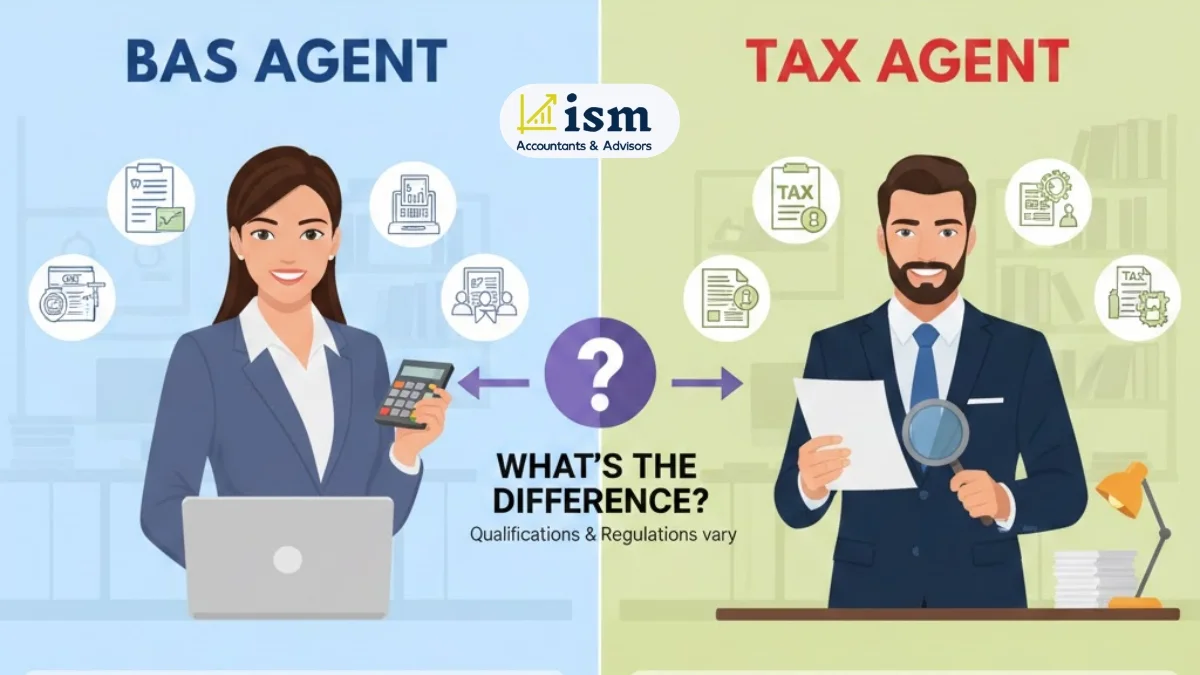

If you’re running a business in Australia, you’ve probably realised pretty quickly that the paperwork never ends. It’s super important to understand the actual difference between a BAS agent and a tax agent so you don’t end up paying for the wrong help. Both of these pros have to have a BAS agent registration TPB or a tax agent registration TPB, so they’re both legit, but they definitely don’t do the same things.
A BAS agent is usually your go-to for the everyday grind. They focus a lot on BAS agent services, which is basically making sure your GST compliance is right and handling PAYG withholding for your staff.
But a tax agent is a bit different. They have the legal power to do everything a BAS agent does, plus they handle the big stuff like your actual income tax returns.
Plus, if you’re worried about the tax agent vs BAS agent cost, just remember that tax agents usually charge more because they can give much broader legal advice.
If you’re over in Perth, ISM Accountants can help you figure out exactly who you need to hire so you’re not overpaying or missing out on important tax breaks.
What is a BAS Agent?
A BAS agent is a professional authorised under the Tax Agent Services Act 2009 (TASA). They are basically the ones who make sure you don’t mess up your paperwork throughout the year. People often call them the “backbone” of small to medium businesses because they handle the boring, routine stuff that keeps your financial health from tanking.
Primary Duties of a BAS Agent
Basically, BAS agents do the tasks that keep you on the right side of Australian tax rules. Here’s what they actually do:
- Preparing and lodging BAS and Instalment Activity Statements (IAS)
- Calculating your GST compliance so you aren’t surprised by a bill
- Managing PAYG withholding for your team
- Making sure your superannuation guarantee compliance is actually being met
Other Services
Plus, a lot of them don’t just stop at tax forms. They offer plenty of other BAS agent services like:
- Small business bookkeeping to keep your records from turning into a shoebox of receipts
- Payroll compliance, including that Single Touch Payroll (STP) stuff
- Setting up bookkeeping systems so you actually know how to use them
Legal Limitations of a BAS Agent
Now, there’s a big difference between a BAS agent and a tax agent when it comes to what they’re allowed to tell you. A BAS agent’s authority is limited to BAS-related provisions. This is important: they cannot provide advice or lodgement services related to income tax. Honestly, if they start giving you income tax advice, they’re actually committing a legal breach.
So, they are perfect if you need regular help with your quarterly BAS, payroll, and keeping the books straight. But for the big tax return? You’ll need someone with a tax agent registration, TPB.
Need a BAS agent in Perth? Reach out to ISM Accountants to streamline your compliance and small business bookkeeping so you can actually focus on running your shop.
What is a Tax Agent?
A tax agent basically has a much broader legal authority than a BAS agent does. They are the only people who are actually allowed to handle every single part of income tax for individuals, companies, trusts, and even partnerships. If you’re looking at the difference between a BAS agent and a tax agent, this is the big one—they cover the whole map.
Primary Duties of a Tax Agent
Tax agents spend most of their time on the heavy-duty stuff. They focus on:
- Preparing and lodging income tax returns (the big yearly ones)
- Giving you strategic tax advice so you aren’t just guessing
- Doing long-term income tax planning to save you money down the road
Advanced Services of a Tax Agent
Because they have a tax agent registration TPB, they can also dive into much more complicated tax issues that would make most people’s heads spin. This includes:
- Capital Gains Tax (CGT) when you sell assets
- Fringe Benefits Tax (FBT)
- Business restructuring if you’re trying to protect your assets or lower your tax bill
Representation Authority
One of the best things about having one is their ATO representation power. They are authorised to stand in your corner and deal with the ATO for things like:
- Audits
- Disputes
- Formal objections
Basically, a tax agent is essential if you need to manage your income tax, plan for better tax efficiency, or just want someone to talk to the ATO for you. When you look at the tax agent vs BAS agent cost, you’re paying for that extra level of legal protection and expertise.
For expert tax agent services in Perth, you should definitely contact ISM Accountants. We’ll make sure your lodgements are spot on and help with the strategic planning. Check out our other services too and see exactly what your business needs to stay ahead.
Recommended Read: Can I Do Bookkeeping Without Being a BAS Agent?
Key Differences Between BAS Agents and Tax Agents
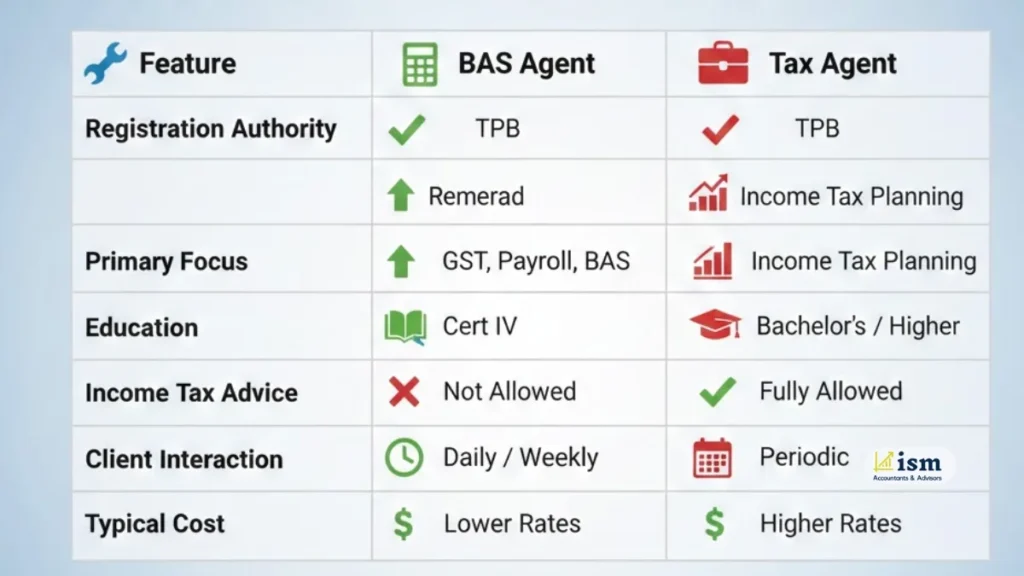
Even though both these guys are pros and have to be registered with the Tax Practitioners Board (TPB), they really do play on different sides of the field. Knowing the difference between a BAS agent and a tax agent is basically the only way to make sure you aren’t hiring the wrong person for the job.
Quick Breakdown
Feature | BAS Agent | Tax Agent |
Registration Authority | BAS agent registration TPB | Tax agent registration TPB |
Primary Focus | GST compliance, payroll, BAS | Income tax planning, strategy |
Education | Cert IV in Accounting/Bookkeeping | Bachelor’s degree or even higher |
Income Tax Advice | Not allowed at all | Fully allowed |
Client Interaction | Usually daily or weekly | Periodic (tax time or reviews) |
Typical Cost | Generally lower hourly rates | Higher rates for specialised help |
As you can see from the list, a BAS agent is usually your best bet for the constant, ongoing stuff, like your GST compliance, getting those BAS lodgements in on time, and handling small business bookkeeping. They keep the engine running.
On the flip side, a tax agent is the one you call for the “big picture” stuff. Their tax agent services are perfect for when you need someone to handle your actual income tax, give you high-level advice, or provide ATO representation if things get tricky.
Honestly, a lot of savvy business owners don’t just pick one. They use both! It’s often the best way to manage the tax agent vs BAS agent cost; you let the BAS agent handle the frequent PAYG withholding and bookkeeping, and then let the tax agent swoop in for the complex year-end strategy. It covers all your bases without blowing the budget.
Recommended Read: Overdue Tax Lodgement Implications
When to Use a BAS Agent vs. a Tax Agent?
Deciding whether to hire a BAS agent or a tax agent really depends on how big your business is, how it’s structured, and what your day-to-day financial needs look like. Both of these pros do important work, but their roles aren’t the same.
Honestly, knowing the difference between a BAS agent and a tax agent is the only way to pick the right expert for things like GST compliance, tax planning, or big-picture strategy. Plus, plenty of businesses actually use both to make sure their records are 100% right and follow Australian tax laws.
Hire a BAS Agent When:
You should probably look for BAS agent services if you’re mostly worried about the “now.” They are great if:
- You need a hand with those quarterly BAS lodgements.
- You need someone to handle payroll and make sure your superannuation compliance is actually on track.
- You want regular small business bookkeeping help so your records don’t turn into a total disaster.
Hire a Tax Agent When:
On the other hand, you definitely need a tax agent for the more complicated legal stuff. Their tax agent services are a must if:
- You need to file an actual company or personal tax return.
- You’re looking for legal tips on income tax planning to lower your tax bill.
- You’re thinking about changing your business structure (like going from a sole trader to a company).
- You’re stuck in an ATO audit or some kind of dispute and need ATO representation.
At the end of the day, it’s about the tax agent vs BAS agent cost and what you need right now. A BAS agent is often better for your wallet for weekly tasks, while a tax agent is worth every cent when it’s time for the big annual tax dive.
Why Many Businesses Use Both BAS Agent and Tax Agents?
A lot of businesses find that it’s actually a huge help to have both a BAS agent and a tax agent on their team. Basically, the BAS agent stays on top of the day-to-day small business bookkeeping and makes sure your records stay accurate all year.
Then, when the end of the year hits, the tax agent uses all that info to sort out the tax return and give you strategic advice. Using both of these pros together keeps your finances accurate and really lowers the risk of making a mistake or getting hit with penalties from the ATO.
Analogy for Understanding
- BAS agent = Like a personal trainer for your business, helping you stay on top of daily financial health and GST compliance.
- Tax agent = Like a specialist consultant who helps with complex income tax planning and ATO representation.
Thinking about it this way makes it pretty easy to see why plenty of businesses feel like they need both professionals to keep things running right.
Final Thoughts
At the end of the day, knowing the difference between a BAS agent and a tax agent is just one of those big things business owners have to wrap their heads around to make the right call. A BAS agent is basically your go-to for keeping up with the regular stuff, like payroll and small business bookkeeping. They make sure your daily numbers are actually right and that you aren’t falling behind.
But, you’re going to need a tax agent for things like filing your actual income tax, getting into income tax planning, or if you ever need ATO representation. Honestly, a lot of businesses end up using both because it’s a solid way to combine their strengths. It helps you stay on top of GST compliance while also making sure your long-term tax strategy is actually smart.
If you’re looking for an expert, you can always consult ISM Accountants for your business taxation or any other accounting services in Perth.
FAQ
A BAS agent handles BAS, GST, PAYG, and bookkeeping compliance, while a tax agent manages income tax returns, strategic tax planning, and ATO representation.
No. BAS agents are legally prohibited from providing income tax advice or lodgements.
Yes. Only tax agents can represent clients in audits, disputes, or objections with the ATO.
Yes. Both BAS agents and tax agents must be registered with the Tax Practitioners Board (TPB) to provide professional services in Australia.
A tax agent can provide:
- Income tax return preparation
- Strategic tax planning
- ATO representation
- Business restructuring advice
No BAS agent can not provide strategic tax advice. Providing strategic or income tax advice is outside a BAS agent’s legal scope.
BAS agents handle GST reporting, BAS lodgements, and payroll compliance for businesses.
Yes. BAS agents often provide bookkeeping systems, payroll processing, and Single Touch Payroll (STP) compliance.
Yes, for quarterly BAS lodgements, GST, payroll, and bookkeeping, but a tax agent is needed for income tax returns and legal tax advice.