
Payroll is one of the few business functions with zero margin for error. Get it wrong, and you’re looking at underpaid staff, missed STP lodgements, or penalties from the ATO. That’s why more Australian businesses are moving away from spreadsheets and manual calculations towards the best payroll software available, tools that automate everything from PAYG withholding to superannuation.
But “best” depends entirely on who’s asking. A 5-person startup, a growing HR team, an accounting firm managing multiple clients, and a business with staff across several states all need different things from payroll software, especially with Payday Super now in effect from 1 July 2026. This guide compares the top payroll platforms of 2026, including Employment Hero, Xero, MYOB, and QuickBooks, by business type and budget, and walks through exactly what to look for before you commit.
Best Payroll Software in Australia at a Glance
Software | Best For | Starting Price | STP Phase 2 |
Employment Hero | All-round payroll & HR | From AUD $10/mo | Yes |
Xero Payroll | Businesses already on Xero | From AUD $7.50/mo | Yes |
MYOB | Growing businesses, inventory | From AUD $35/mo + payroll add-on | Yes |
QuickBooks Payroll | QuickBooks users | AUD $6/employee/mo (on top of QBO) | Yes |
Reckon Payroll | Budget-conscious small business | From AUD $16/mo flat | Yes |
Microkeeper | Shift-based & award-heavy industries | From AUD $2.25/employee/mo | Yes |
Payroller | Sole traders & micro-employers | Free (single employee) | Yes |
Rippling | Payroll, HR & IT combined | Custom (modular) | Yes |
Deel | Global payroll & contractors | From AUD $1/worker/mo | Yes (AU) |
9 Best Payroll Software Platforms in 2027
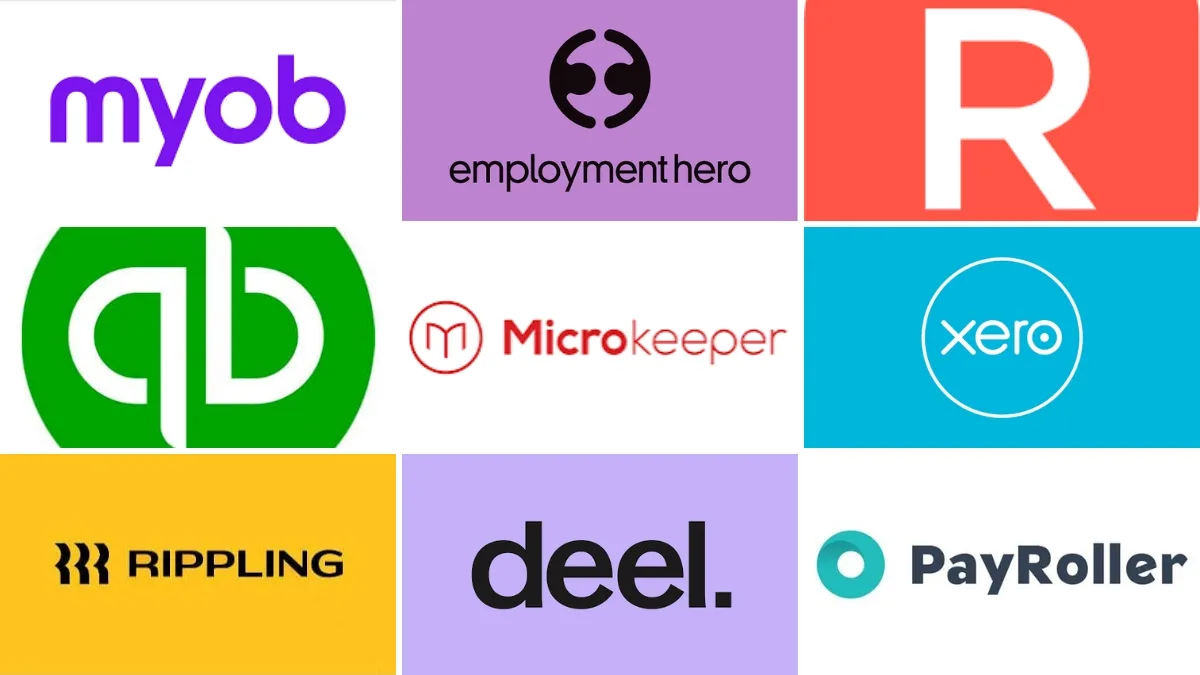
Each platform below was picked for a specific strength, whether that’s price, award compliance, or global reach, so you can quickly match a tool to your actual situation.
1. Employment Hero: Best All-Round Payroll and HR
Employment Hero combines automated payroll, modern award interpretation, STP Phase 2 reporting, and a full HR stack in one system. Its HeroClear feature is built specifically for Payday Super, calculating and disbursing super every pay cycle rather than quarterly.
- Strengths: Deepest Australian compliance available, award interpretation engine, employee self-service app.
- Watch for: No fixed monthly commitment plans mean pricing can add up for very small teams.
2. Xero Payroll: Best for Businesses Already on Xero
If your books already run on Xero, payroll is built in and syncs automatically; no separate reconciliation is needed. Automated Payday Super and STP Phase 2 come standard on every plan, making it a strong pick for small businesses that want everything in one place.
- Strengths: Seamless accounting sync, widely used by Australian accountants and book-keepers, easy setup.
- Watch for: pricing rises once you exceed your plan’s employee cap; limited standalone workforce management tools.
3. MYOB: Best for Growing Businesses
Founded in 1991, MYOB pairs deep ATO compliance with strong inventory and job-costing tools, making it a common pick for the best payroll software for accountants managing product-based or trade businesses. STP Phase 2 and Superannuation are built in, with an optional self-service app for timesheets.
- Strengths: Mature, well-established platform; unlimited payroll on higher tiers; strong Australian compliance record.
- Watch for: Pricing structure can be fiddly across tiers; the interface feels dated next to newer competitors.
4. QuickBooks Payroll: Best for QuickBooks Users
For businesses already doing their books in QuickBooks Online, payroll (powered by Employment Hero under the hood) syncs directly with the existing ledger. This gives it strong compliance credentials despite being positioned as an add-on rather than a native feature.
- Strengths: Native QuickBooks integration, access to Employment Hero’s award engine, and and affordable per-employee pricing.
- Watch for: a smaller AU-specific payroll footprint than Xero or MYOB; better suited to those already on QuickBooks.
Recommended Read: Xero vs Myob vs Quickbooks
5. Reckon Payroll: Best Value for Small Business
Reckon stands out with flat-rate pricing that doesn’t scale per employee, a genuine advantage as your team grows. It’s STP Phase 2 and Payday Super ready, with data hosted entirely in Australia.
- Strengths: Predictable flat pricing, built and hosted in Australia, straightforward EOFY reporting.
- Watch for: Fewer advanced features compared to premium platforms.
6. Microkeeper: Best for Shift-Based Teams
Microkeeper unifies payroll, rostering, and time and attendance in one platform, making it a strong choice for hospitality, retail, healthcare, and other award-heavy, shift-based industries.
- Strengths: Transparent per-employee pricing, real-time labour cost visibility, scales to large shift-based workforces.
- Watch for: Rostering setup can be complex across multiple departments.
7. Payroller: Best for Sole Traders and Micro Employers
Payroller offers a free, STP-compliant mobile app for single-employee payroll, making it a common starting point for sole traders before they scale up to a paid plan.
- Strengths: Genuinely free entry point, simple setup, widely used by micro businesses.
- Watch for: Costs appear as soon as you add a second employee or need the web app.
8. Rippling: Best for Payroll, HR and IT Combined
Rippling unifies payroll, HR, and IT device management in one system, useful for tech-forward businesses onboarding staff remotely. It also offers Employer of Record (EOR) services in 185+ countries, making it a strong option for the best payroll software for HR teams managing distributed staff.
- Strengths: Fast pay runs, modular pricing, strong global reach.
- Watch for: Can feel like more infrastructure than an Australia-only small business needs.
9. Deel: Best Global Payroll Software
Deel handles compliant international payroll and contractor payments across 150+ countries, including full STP 2 support for Australian entities hiring globally. It’s the clear front-runner for the best global payroll software or the best payroll software for remote teams.
- Strengths: Strong global compliance coverage, fast multi-currency payouts, simplified international hiring.
- Watch for: likely overkill if your workforce is entirely Australia-based.
Not sure which payroll setup is right for your business? ISM Accountants helps businesses simplify payroll, bookkeeping, and compliance.
What Features Should Payroll Software Have?
Not every payroll platform covers the same ground, especially with Payday Super now in effect. Here’s what to check before you commit.
- STP Phase 2 reporting: automatically reports disaggregated gross pay, income types, and employment details to the ATO with every pay run, building on the Single Touch Payroll requirements small businesses already report under.
- Payday Super support: calculates and disburses superannuation every pay cycle rather than quarterly, so contributions land within 7 business days as required.
- Award interpretation: automatically applies correct pay rates, penalties, overtime, and allowances, critical for hospitality, retail, and healthcare.
- Automated tax calculations: PAYG withholding, Medicare levy, and HELP/STSL repayments calculated using current ATO tax tables.
- Employee self-service: a portal or app for payslips, leave requests, and super details without going through HR.
- Accounting integrations: native syncing with Xero, MYOB, or QuickBooks to keep books and payroll aligned.
- Reporting and compliance: real-time dashboards on labour costs and leave liabilities, backed by audit-ready records.
Types of Payroll Software: Which One Fits Your Business
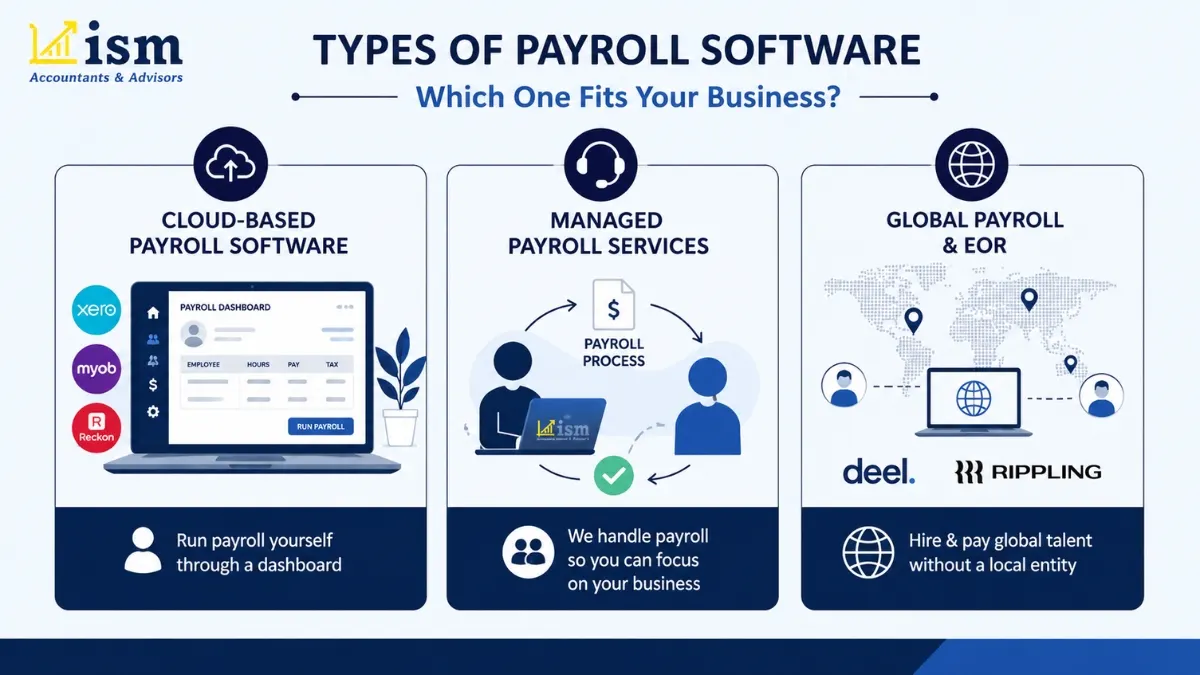
Payroll software isn’t one single category. The right option depends on how much control you want to keep in-house versus hand off to a provider.
- Cloud-based payroll software: self-service platforms like Xero, MYOB, and Reckon, similar to the cloud accounting software many Australian small businesses already run their books on, where you run payroll yourself through a dashboard.
- Managed payroll services: an accounting firm or book-keeper handles most of the payroll process on your behalf, similar to ISM Accountants’ payroll management services, ideal for businesses without an in-house payroll administrator.
- Global payroll and EOR: Deel and Rippling’s global arm lets you hire and pay international staff or contractors without setting up a local legal entity overseas.
How to Choose the Best Payroll Software
Once you know what features matter, narrowing down the actual decision comes down to a handful of practical checks.
- Consider your employee count: a 5-person team and a 100-person business have very different needs. Smaller teams benefit from simple, affordable tools, while larger ones need scalability and deeper award compliance.
- Check Payday Super readiness: confirm the platform can calculate and disburse super every pay cycle, not just quarterly, since this is now mandatory.
- Review your award and industry requirements: hospitality, retail, and healthcare businesses need strong award interpretation built in, not bolted on.
- Check integrations: confirm native support for your existing accounting software and time-tracking tools.
- Calculate total cost: add up the base fee, per-employee costs, and super processing fees, alongside your payroll tax obligations, to get a realistic monthly cost.
- Evaluate support: decide whether self-service is enough or whether you’d rather hand payroll off to a book-keeper or accountant entirely.
Final Thoughts
If you want one straightforward recommendation, Employment Hero is the strongest all-round pick thanks to its depth of Australian compliance and built-in Payday Super support. Xero and MYOB are better choices if you want payroll built into accounting software you already use, and Deel or Rippling make sense once your business hires beyond Australia.
Ultimately, the best payroll software is the one that matches your headcount, award requirements, and existing tools today while staying ready for Payday Super and STP Phase 2 as they evolve. Use the comparison table and reviews above to shortlist two or three options, then take advantage of free trials or demos before you commit.
Still weighing up your options? Get in touch with ISM Accountants for tailored advice on the right payroll setup for your business.
Frequently Asked Questions
What is the best payroll software in Australia?
There’s no single best option. Employment Hero, Xero, and MYOB are consistently top-ranked, but the right choice depends on your company size, budget, and whether you’re already using a specific accounting platform.
What is the best payroll software for small businesses and startups?
Xero Payroll and Reckon suit small businesses thanks to affordable, predictable pricing and built-in STP compliance. Employment Hero is a strong pick for startups planning to scale, since it bundles award interpretation and HR from day one.
How much does payroll software cost in Australia?
Most platforms charge from AUD $7.50–$35/month plus a per-employee fee, though some like Reckon offer flat-rate pricing regardless of headcount. Payroller is free for single-employee payroll via its mobile app.
What features should payroll software have?
At minimum: STP Phase 2 reporting, Payday Super support, automated PAYG withholding, and integrations with your accounting software. Award-heavy industries should also prioritise automated award interpretation.
Is there free payroll software in Australia?
Yes. Payroller offers free STP-compliant payroll for single-employee pay runs via its mobile app, with fees applying once you add employees or use the web app.
What is the best payroll software for global teams?
Deel and Rippling lead this category, both supporting compliant payments to employees and contractors across 150+ countries while maintaining STP 2 compliance for Australian entities.
What's the difference between payroll software and payroll services?
Payroll software is self-service; you or your team run payroll yourselves. Payroll services, like outsourcing to a book-keeper or accounting firm, hand the process off entirely. Software is cheaper and gives more control; services cost more but save internal time and reduce compliance risk.