
Most startup founders think getting the loan approved is the hard part. It’s not. What happens after the money hits your account is where things actually get complicated.
Effective loan management for startups in Australia isn’t just about making repayments on time. It’s about understanding how debt fits into your tax position, your cash flow cycle, your R&D claims, and your long-term fundability. Get that right, and debt becomes one of your strongest growth tools. Get it wrong, and it quietly eats into your runway faster than any slow sales month ever could.
At ISM Accountants in Perth, we work with founders across Sydney, Melbourne, Brisbane, and Perth who are navigating exactly this. This guide covers what we actually advise, not textbook theory, but the practical financial management strategies for startups that make a real difference.
Quick Summary
- Before you borrow: Get your cash flow forecasts and financial records in order first
- Debt is strategic: Align repayments with your actual revenue cycles, not projections
- Tax matters early: ATO interest deductibility rules have changed, know what you can and can’t claim
- Use the tools available: Cloud accounting platforms like Xero and MYOB aren’t optional admin, they’re strategic infrastructure
- Plan for your next raise: Clean PPSR records and debt structure affect investor confidence more than most founders realise
Ways for Effective Loan Management for Startups in Australia
Before starting any business, you need to be financially strong. Financial well being defines your future startups health. If you jumps in to the business in a rush, you may have to face a huge loss. Therefore first make your finance strong through effective loan management in Australia. Here are some of the management tips
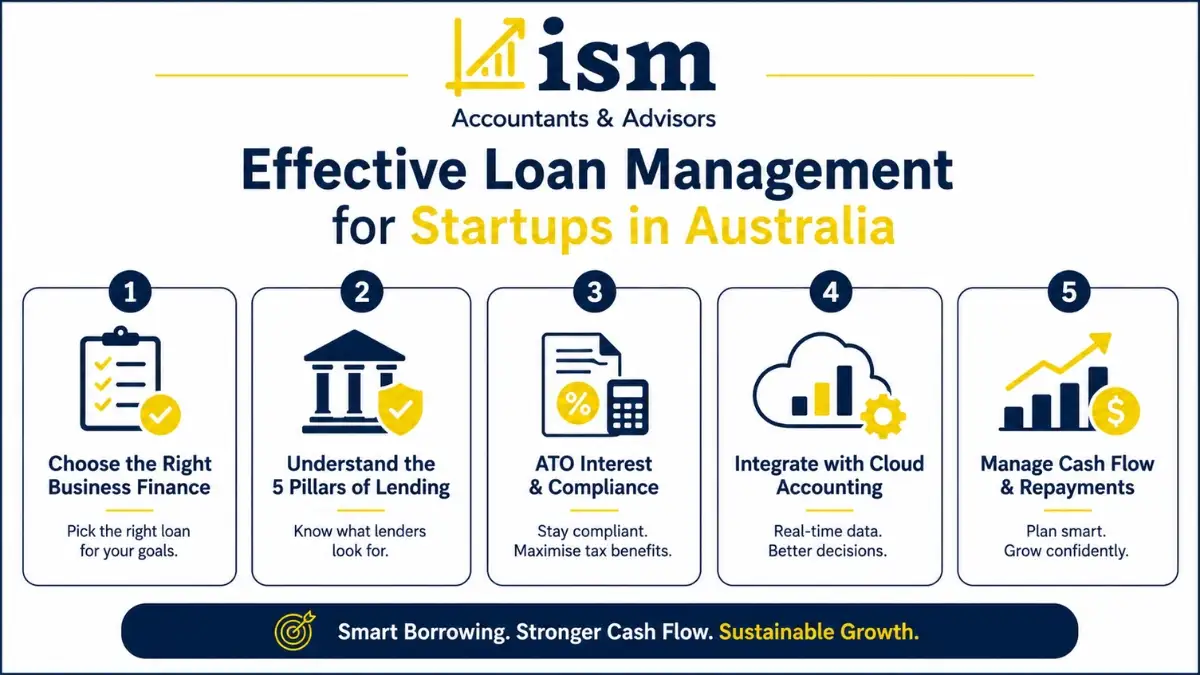
1. Pick the Right Type of Business Finance First
Not all startup business finance in Australia is created equal. Choosing the wrong product, even at a great rate, can quietly hurt your cash flow and tax position.
Here’s a quick decision guide:
- Buying equipment? Equipment finance beats a general loan. The asset backs the deal, and the tax treatment is usually cleaner.
- Uneven revenue? A line of credit lets you draw and repay flexibly. You only pay interest on what you use.
- Waiting on invoices? Invoice finance turns unpaid bills into working capital without locking you into long-term debt.
- Worried about dilution? Venture debt can delay your next equity round and let you retain more ownership while you hit your milestones.
Also worth knowing: The R&D Tax Incentive can return up to 43.5% of eligible R&D spend through the ATO. That’s not a loan, it’s your own money back. Many founders use it to reduce short-term repayment pressure entirely.
Always read the loan covenants before signing. Restrictive conditions on cash balances or additional borrowing can cost you more than a slightly higher rate ever would.
2. Understand the 5 Pillars of Lending Before You Apply
When any Australian lender, bank or alternative, reviews your application for business finance for startups, they’re looking at five things:
Pillar | What Lenders Actually Check |
Serviceability | Can you repay from real revenue, not projections? |
Security | What assets or guarantees back the loan? |
Structure | Does the loan type match how you’ll use the funds? |
Risk Assessment | How does your stage and sector look to this lender? |
Compliance | Are your records, agreements and ATO obligations clean? |
These also connect directly to the 5 C’s of lending, Character, Capacity, Capital, Collateral, and Conditions. Understanding both frameworks helps you walk into any lender conversation prepared, not reactive.
Recommended Read: Accounting Tips For Freelancers
3. ATO Interest Deductibility: What Changed and What Founders Miss
This is where we see the most expensive mistakes in startup financial management.
- The core rule: Under the ATO’s purpose test, business loan interest is generally deductible if the borrowed funds are used to generate assessable income. The problem? Messy records or mixed-use funds can kill that deduction fast.
- What changed from 1 July 2025: General Interest Charges (GIC) and Shortfall Interest Charges (SIC) on ATO tax debts are no longer tax deductible. That makes ATO debt more expensive than it looks. Many SMEs are now refinancing ATO payment arrangements through external lenders, where interest may still be deductible, it’s a strategic move, not just a cash flow one.
- The Division 7A trap: If you’ve borrowed from your own private company without a formal agreement at ATO benchmark interest rates, the ATO can treat that as a deemed dividend, triggering income tax and penalties. The fix is straightforward but must be done properly. Don’t leave this unaddressed.
Use what’s available:
- R&D Tax Incentive: up to 43.5% back on eligible expenditure
- Digitisation Bonus Deduction: an extra 20% on eligible tech purchases
Both require accurate record-keeping. Your accounting system needs to be doing the work here, which brings us to the next point.
4. Integrate Your Debt with Cloud Accounting from Day One
Manual spreadsheets don’t scale, and they won’t impress a lender or survive an ATO review.
Cloud platforms like Xero and MYOB connect directly to Australian banks and many alternative lenders via API. That means real-time financial data, faster credit decisions, and approvals that can happen in hours rather than weeks.
Beyond speed, integration matters for three practical reasons:
- Correct principal vs interest splitting. Recording full repayments as expenses is one of the most common bookkeeping errors we see. It distorts your profit, misrepresents your financial position, and creates incorrect tax claims, especially now that ATO interest is no longer deductible.
- Runway visibility. When your debt schedule is built into your forecasting model, you can see cash tightening 3–6 months out rather than reacting when it’s already a problem.
- R&D and compliance tracking. Claiming the R&D Tax Incentive requires detailed, category-level expense tracking. The right accounting setup makes this automatic. The wrong setup means leaving money on the table or having a claim rejected.
The best financial management software for startups in Australia isn’t about the brand, it’s about whether it’s configured correctly from the start.
Recommended Read: Tax Deductions for Nurses and Midwives
5. Startup Cash Flow Management: Budgeting Around Repayments
Strong financial planning for startups starts with one honest question: can you still service this debt if revenue comes in 30–40% below forecast?
If the answer is no, the loan is too large. Here’s how we advise founders to think about it:
- Allocate borrowed capital to revenue-generating activities first. Office fit-outs and premature hires burn capital without clear return. If there’s no measurable ROI pathway, the spend needs to be questioned.
- Match repayments to your revenue cycle. Seasonal or project-based businesses should negotiate repayment flexibility before signing, not after.
- Set KPIs linked to the debt. Borrowed for marketing? Track ROAS. Borrowed for equipment? Track utilisation. Debt without performance metrics is just cost.
- Review your loan every 12–18 months. Business loan interest rates in Australia shift, and refinancing at the right time can meaningfully reduce overhead.
Recommended Read: Tax Planning Strategy in Australia
Common Reasons Startup Loans Fail in Australia
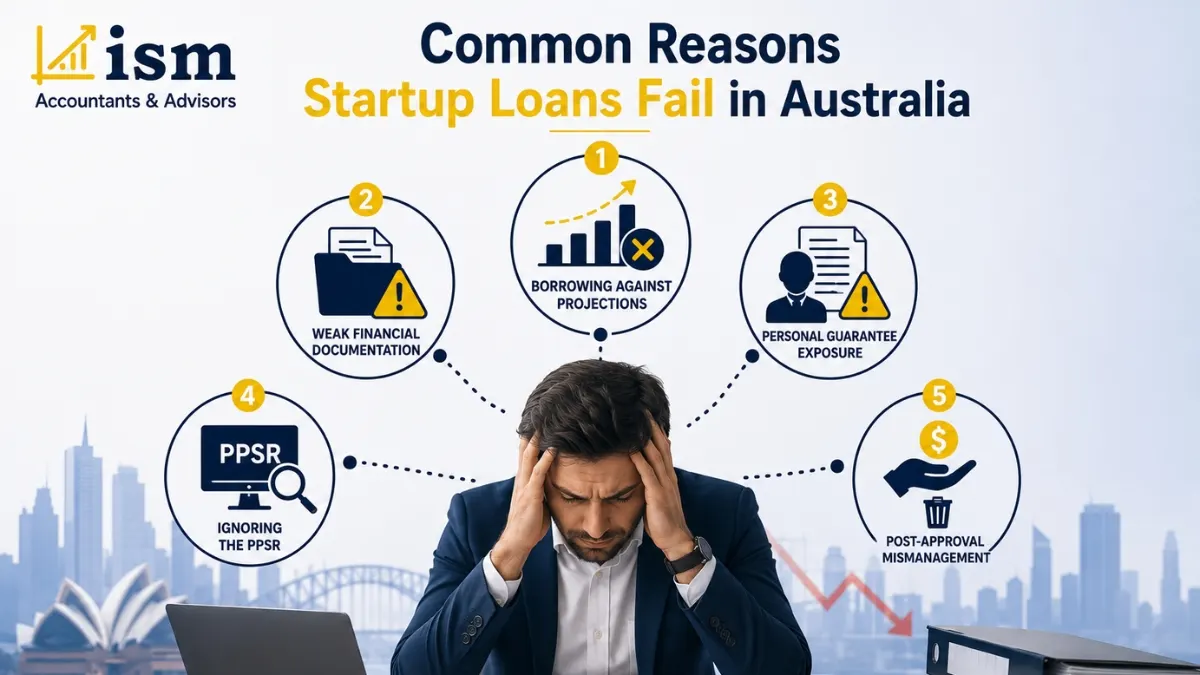
Most loan failures aren’t bad luck. They’re patterns we see repeatedly:
- Borrowing against projections. Taking the maximum loan offered without stress-testing against conservative revenue scenarios. When sales dip, repayments become unmanageable fast.
- Weak financial documentation. Incomplete profit and loss statements, no cash flow forecast, no repayment roadmap. Even alternative lenders need to see the numbers, and messy records signal risk, which increases your pricing.
- Personal guarantee exposure. Signing personal guarantees without fully understanding the trigger conditions or what assets are at risk. This needs proper review before signing, not after.
- Ignoring the PPSR. Old or unreleased security interests on the Personal Property Securities Register show up in investor due diligence. If you’re preparing for a capital raise, your PPSR records need to be clean first.
- Post-approval mismanagement. Spending loan proceeds on non-essential expenses or deviating from the original allocation plan. Capital should be trackable back to measurable return.
Business Loan Interest Rates in Australia: What to Expect
Startup business loan rates vary significantly based on security, trading history, and lender type:
- Secured loans (property or asset-backed): roughly 6%–10% per annum
- Unsecured startup business loans: typically 12%–20%+
- Equipment finance: generally 7%–12%, reflecting the asset-backed security
- Invoice finance / lines of credit: often 15%–25% when annualised
For a $50,000 business loan at 10% over five years, monthly repayments are approximately $1,060. At an unsecured rate of 18%, that rises to around $1,270. Always model repayments against your conservative cash flow scenario, not your best-case projection.
Traditional banks are cheaper but slower and harder to qualify for without trading history. Alternative lenders move fast but price for that risk. The right choice depends on your timeline and whether speed has real dollar value in your situation.
Final Thoughts
Debt isn’t the enemy. Poor planning around debt is.
When effective loan management for startups in Australia is done properly, structured correctly, tracked in cloud accounting, aligned with ATO rules, and reviewed regularly, it genuinely supports growth instead of dragging on it.
At ISM Accountants, we work with founders across Perth, Sydney, Melbourne, Brisbane, and Adelaide on exactly this: loan structure reviews, pre-raise debt audits, Division 7A compliance, and financial strategy that connects tax planning with business growth.
If you’re not sure whether your current loan structure is working as hard as it should be, contact ISM Accountants for a straightforward conversation.
Frequently Asked Questions
What are the 5 C's of lending?
Character, Capacity, Capital, Collateral, and Conditions. Lenders use these to assess your credit history, ability to repay, financial contribution to the business, available security, and the broader economic environment.
What are the 5 pillars of lending?
Serviceability, security, structure, risk assessment, and compliance. These focus on whether the loan itself is appropriately designed, not just whether the borrower qualifies.
What are the 5 P's of lending?
Person, Purpose, Payment, Protection, and Perspective. In practice: who you are, why you need the loan, how you’ll repay it, what protects the lender, and the overall risk outlook.
What is the monthly payment on a $50,000 business loan?
At 10% over five years, approximately $1,060 per month. At 18%, closer to $1,270. Always model repayments against a conservative revenue scenario.
Is business loan interest tax deductible in Australia?
Generally yes, if funds are used to generate assessable income. However, from 1 July 2025, ATO interest charges (GIC and SIC) are no longer deductible. Accurate records of how loan funds are allocated are essential.
Which bank has the most complaints in Australia?
Complaint volumes change annually and largely reflect institution size. For current data, check reports published by the Australian Financial Complaints Authority (AFCA).
What is the best financial management software for startups?
Xero and MYOB are the most widely used in Australia. The platform matters less than whether it’s correctly configured, chart of accounts, loan schedules, and expense categories need to be set up properly from day one.
Can I use my R&D Tax Incentive refund to repay a business loan?
Yes. Many founders align repayment schedules with their expected R&D refund, up to 43.5% of eligible expenditure, to smooth cash flow without taking on additional debt.